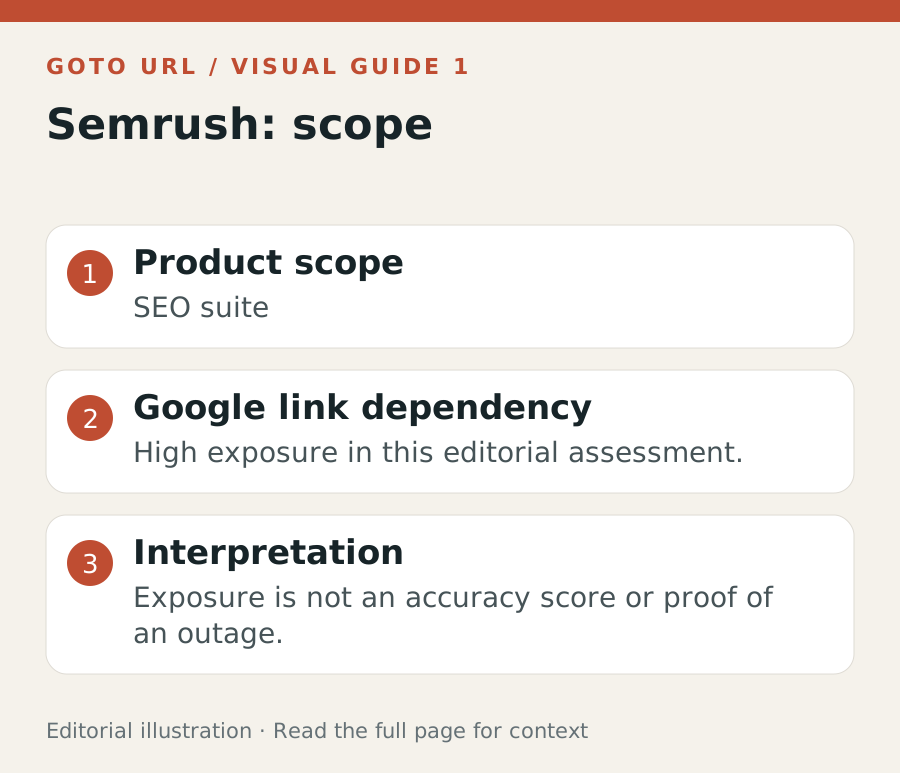
What Semrush provides
Semrush is a public digital-marketing software company offering SEO, advertising, content, local and competitive-intelligence products.
Position Tracking monitors domains and competitors across keywords, devices and locations. Semrush also maintains large organic and advertising databases built from recurring search observation.
Where the redirect matters
Exposure is concentrated in rank tracking, organic research, SERP snapshots and any feature that must associate a Google position with an exact landing page. Site audits, independent backlink crawlers and most workflow tools do not use Google result anchors. A problem in one data layer should not be described as a failure of the whole suite. Its scale gives it strong engineering options, but also makes any extra per-result resolution expensive.
/goto?url=[hash]resolve + attributepublisher URL
What Semrush has said
Specific /goto responseSemrush says customers saw no impact on rank tracking, reporting or data accuracy because its team knew about the change and addressed it quickly.
Semrush does not say whether it changed its own collector, resolves destinations by another field, uses an upstream supplier or blends alternative data. The phrase ‘addressed it quickly’ indicates mitigation work; it supports no customer-visible effect, not no effect on Semrush’s internal systems.
The claim is strongly worded and usefully scoped to customer outcomes, but technically vague. There is no named affected surface, sample, accuracy benchmark, latency measure or audit. Practical Ecommerce reported seeing some Google intermediary URLs in Semrush earlier in August and fewer later, which supports adaptation but makes ‘not affected’ too broad if read literally.
No /goto-specific price, keyword allowance, update-frequency or result-depth change was announced. With no mechanism or cost figures, it is not possible to tell whether Semrush absorbed additional expense or avoided it technically.
What is known — and what is not
The source record above is the latest attributable evidence located for Semrush. Its stated outcome is not treated as an independent accuracy audit: the exposure rating still describes the relevant product’s dependence on resolving live Google result URLs.
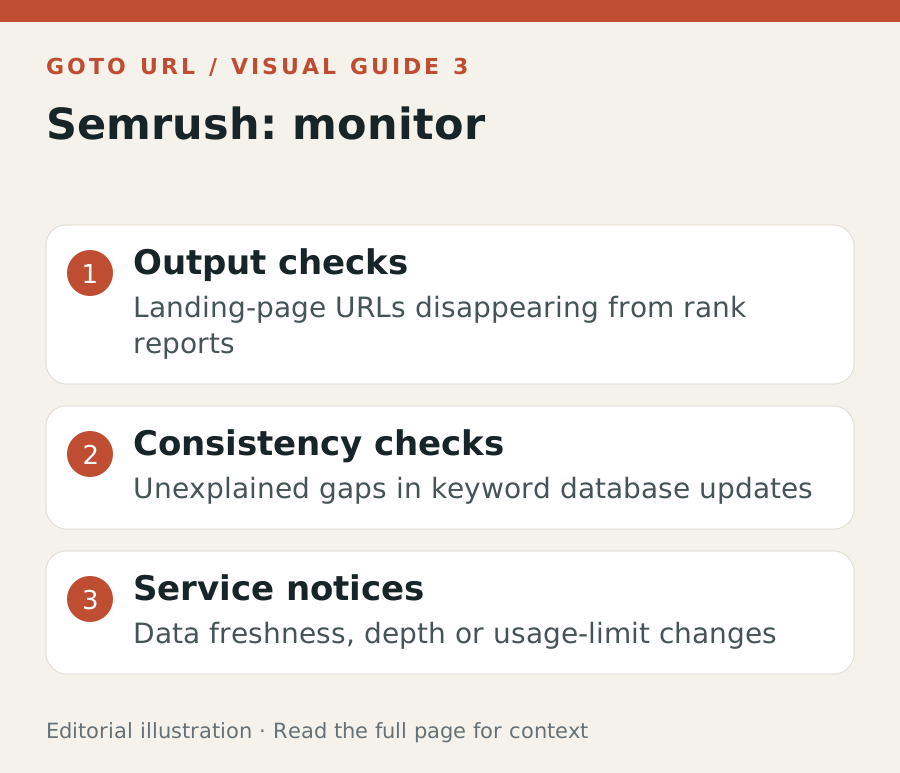
What customers should monitor
- Landing-page URLs disappearing from rank reports
- Unexplained gaps in keyword database updates
- Data freshness, depth or usage-limit changes
What should remain outside the change
- Site audits that crawl the customer’s website directly
- Backlink and workflow features not sourced from live Google links
Read rank checks alongside Search Console
Match query, country, device and dates before comparing a tracker with GSC. Average position describes recorded impressions; it is not a fixed-location check. Review the reported page and clicks when a URL switches, and investigate whether the change is harmful before treating it as cannibalisation.
Use a fixed commercial watchlist alongside wider query discovery and lead outcomes. A missing check or incomplete SERP is not a measured ranking loss. Our SEO Stack review explains the measurements, and the Google analysis separates result-depth, access and URL-resolution failures.