SEO Stack review: features, pricing and the ranking claims
Search Console reporting and conventional rank checks answer different questions. SEO Stack’s approach is useful for analysing your own site, provided you understand what Google supplies and what it leaves out.
Our verdict
SEO Stack is worth evaluating when your bottleneck is analysing and retaining your own sites’ Search Console data. Its strongest case is the workflow around that data: query discovery, segmentation, history and connecting search performance to landing-page outcomes. It is less convincing as a blanket replacement for a specialist local or competitor rank tracker.
Strengths
- A broader own-site view than a small, preselected keyword report.
- Stored history can support longer-term comparisons if ingestion and retention work as documented.
- Search and landing-page analysis can help prioritise work around useful visits.
- The GSC reporting path avoids resolving live Google result links.
Limitations
- Average position is not a controlled local rank or guaranteed top-100 result set.
- Upstream omissions and reporting errors remain relevant.
- Daily and unlimited tracking claims need reconciling with plan allowances.
- A multi-site subscription may be difficult to justify for one small website.
What is SEO Stack, and who is behind it?
The company attributes the idea to founder Daniel Foley Carter in 2020, followed by a first iteration in 2021, V2 in 2024 and V3 in 2026. Ram Karri is listed as leading development. These are supplier-published details; user totals and scale claims are not independently verified here. Company background.
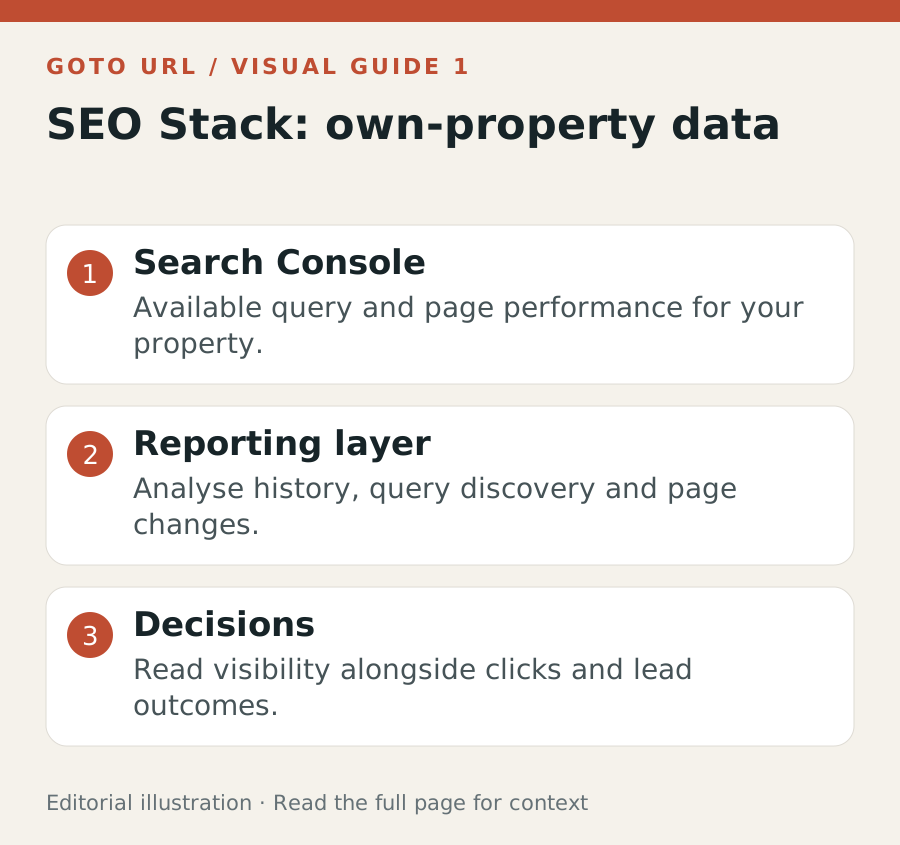
What SEO Stack adds
SEO Stack describes rankings derived from Search Console, with keyword groups, movement reports, page associations and country/device filters. Its warehouse retains imported history, with GA4 and other analysis alongside it. These are documented capabilities, not results from our own account test. Rank-tracking documentation; warehouse documentation.
Our assessment: its strongest use is finding opportunities in the queries your site already receives, then checking whether visibility changes produce useful visits. A separate rank tracker can add controlled market checks and competitive context.
Features beyond the ranking report
Search Console warehousing and GA4
The documented workflow imports available property history after Google account connection. It offers saved layered filters, annotations and GA4 metrics alongside search performance. Storing retrieved rows can improve analysis beyond a small interface export and preserve history after it leaves Google’s rolling window. It cannot recreate older data nobody saved. Warehouse documentation.
Our assessment: saved segments and annotations can be more useful than a headline row count because they let a team repeat the same analysis. GA4 alongside GSC can expose pages with visibility but weak conversion; it does not identify which individual organic query produced a customer.
AI visibility
The module describes prompt monitoring, brand mentions, linked citations, sentiment and competitor comparisons. This is a separate measurement source from GSC. A sampled answer share does not measure total market exposure, referrals or sales; inspect the prompts, engine, dates and returned evidence. AI visibility documentation.
Technical audits and content analysis
The site auditor documents homepage, full-site and page-level runs, device settings and optional JavaScript rendering. It lists its own crawler, DataForSEO and Firecrawl as selectable sources. The content auditor assesses areas such as intent alignment, clarity and trust signals with written suggestions. These are documented capabilities, not verified audit outcomes. Site audit; content auditor.
Trial the modules against a page with known issues. Verify rendering, affected URLs and the evidence behind recommendations. An AI quality score is neither Google’s score nor proof that an edit will improve rankings.
MCP access and data handling
MCP connects an AI assistant or agent to tools and data. SEO Stack documents access to its warehoused GSC, GA4 and AI visibility datasets. The potential benefit is querying retained data without rebuilding reports each time. Confirm permissions and export behaviour on a representative task. MCP documentation.
The data-handling page describes an identity-verified deletion request and a 30-day processing period. That does not verify every security claim. For client data, establish processing terms, property access separation, AI subprocessors and cancellation/export rights appropriate to your organisation. Data-handling policy.
SEO Stack pricing and plan limits
Advertised USD monthly prices checked on 12 October 2026; confirm tax, currency conversion and checkout terms.
| Plan | Monthly price | Websites | Seats | Warehouse retention | Pooled tracked keywords |
|---|---|---|---|---|---|
| Basic | $129.99 | 10 | 5 | 60 months | 750 |
| Pro | $349.99 | 30 | 10 | 60 months | 3,000 |
| Agency | $679.99 | 200 | 15 | 120+ months | 10,000 |
The pricing table lists weekly default checks, with daily checking via an add-on on Pro and Agency. Basic lists desktop; Pro adds mobile; Agency adds multi-location. Extra properties are $10/month. Annual billing advertises a 17% saving. Single Site and Lite are closed to new customers. The 14-day trial requires a card and cancellation within the trial to avoid billing. Official pricing and allowances.
Our buying assessment: compare cost with reporting time saved and decisions improved. A portfolio of sites has a different value calculation from one site needing a weekly report. Retention allowances describe storage capacity, not a promise of five or ten years of past data immediately.
Search Console average position vs a rank check
Google averages the topmost position of the property or page for the selected grouping across impressions. It is not a reproducible, fixed-location rank. Links within one search element can also share a position. Google’s measurement definitions.
| Consideration | Search Console approach | Conventional rank tracking |
|---|---|---|
| Question answered | Where did this property receive search exposure? | Where does a target appear in a configured search check? |
| Position | An average across recorded impressions; aggregation and result type matter. | An observation for a chosen query, time, location and device; methodology varies. |
| Keyword discovery | Finds available queries you did not choose in advance; privacy and extraction limits apply. | Checks configured terms, including those with no Search Console impressions; verify custom keyword support. |
| Market detail | Country and device segments; not a fixed city or postcode check. | May support city, postcode or map-grid checks, depending on the product. |
| Competitors | Requires permission to access each property’s Search Console data. | Can observe competitors in the same collected results without their Search Console access. |
| Collection risk | Depends on Google’s API, reporting rules, permissions and the importer. | Depends on search-result access, parsing, depth, refreshes and any upstream supplier. |
The conventional-tracker column describes possible workflows, not features guaranteed in every product. Compare specific products in the tool catalogue.
Does SEO Stack’s Google critique stand up?
Daniel Foley Carter’s 7 October article argues that a small keyword watchlist can misrepresent overall progress, that Google’s collection changes add operational work, and that first-party reporting offers an alternative. Those are useful distinctions. It is also written by the product’s founder, so the buying conclusions need scrutiny. Original critique.
A broader footprint is useful, but growth alone is not success
A service business could gain hundreds of irrelevant informational queries while losing visibility on terms that generate enquiries. Our interpretation: report a fixed commercial watchlist alongside available query breadth, clicks and qualified conversions. Query count is a diagnostic measure, not a revenue proxy.
Stored first-party data can inherit reporting errors
Google records an impressions logging error from 13 May 2025 to 27 April 2026 that also affected CTR and average position, but not clicks. This affected reporting, rather than actual search performance. Annotate the period in stored trends; a warehouse does not automatically repair the source. Google’s anomaly record.
Collection costs and Google’s motive need separate evidence
The article’s ten-request example illustrates a possible collection burden, not a universal vendor cost multiplier. Logged-out observations also do not establish behaviour in every session. Google restricts automated rank-check scraping; that does not establish every motive behind a technical change or a ranking penalty for a customer using a tracker. Machine-generated traffic policy; our evidence assessment.
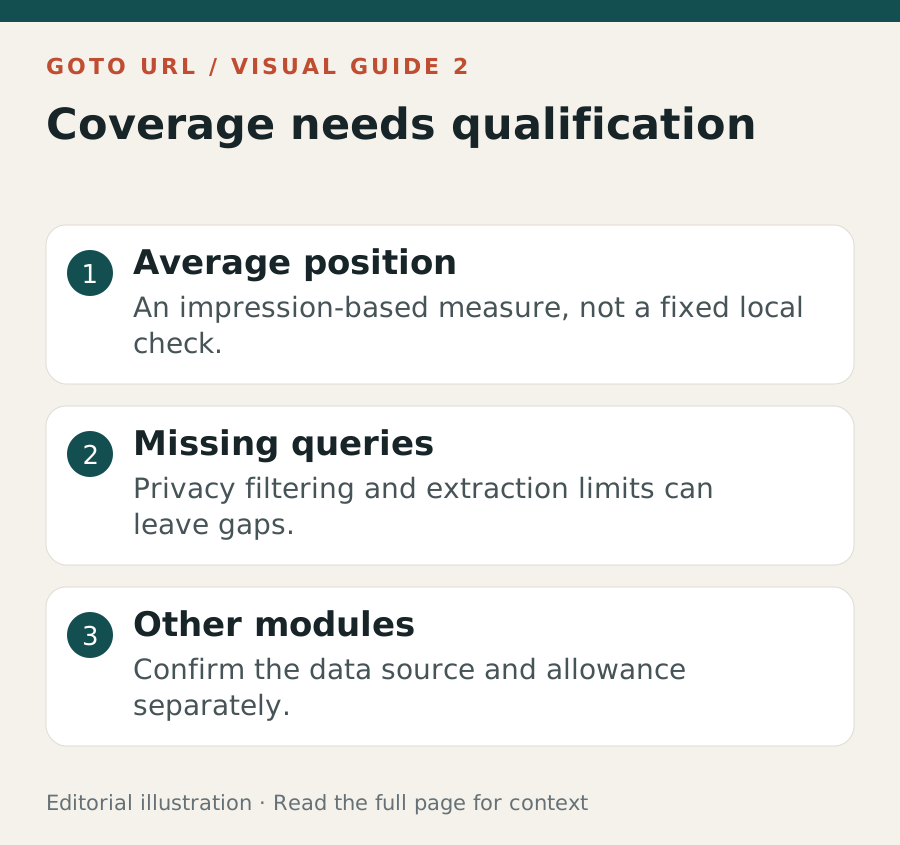
Which claims stand up?
Complete keyword coverage needs qualification
The rank-tracking page presents coverage as every keyword. Google suppresses some query text for privacy, and its API does not guarantee every data row. SEO Stack’s own warehouse page acknowledges the privacy exception. The defensible interpretation is access to the queries its importer can retrieve, not a complete list of everything you rank for. Google’s privacy and row-limit explanation; API documentation; SEO Stack’s qualification.
Warehousing does not eliminate upstream API limits
Google allows up to 25,000 rows per API request with pagination, but still does not guarantee every data row. Retaining retrieved data and querying a large warehouse are different from proving complete ingestion. Ask how SEO Stack handles missing days, row limits and source revisions. Its own blog’s acknowledgement of API limits conflicts with its broader immunity wording. Google’s API contract.
Deep positions are observations, not continuous top-100 coverage
The advertised position-100 coverage needs an important boundary: Google records position only when an impression occurs. Missing data cannot tell you whether a page is absent, too deep to receive exposure or withheld from the report. Do not turn a blank into position 100 or a confirmed ranking loss. Google’s impression requirement.
A keyword database is not a necessary tracking prerequisite
The vendor’s comparison overgeneralises conventional trackers. Keyword research databases and configured rank checks are different functions. Check whether the product accepts your own terms and how it charges for them; a reported search volume of zero is not evidence that nobody searches or that the term cannot be checked.
Several ranking URLs are a diagnostic clue
URL movement warrants investigation, but two pages appearing for a query do not by themselves prove harmful cannibalisation. Compare query intent, page-level clicks, dates and canonical choices before merging or redirecting useful pages. Google generally attributes performance to its selected canonical URL, which can complicate the apparent page history. Google’s URL attribution rules.
First-party data still needs interpretation
Google-origin data is valuable, but privacy rules, aggregation, reporting delays and changes in the search mix still apply. A better position is not proof of additional revenue; compare clicks, qualified enquiries and sales. Google’s reporting caveats.
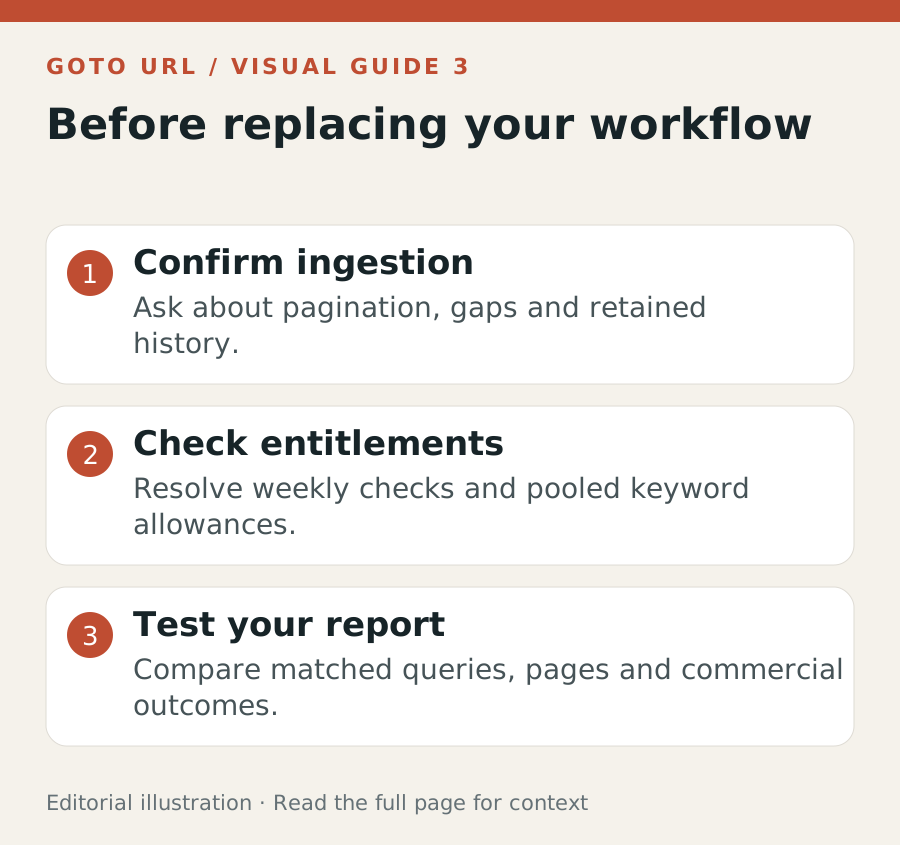
A practical workflow for your own website
- Discover available long-tail queries. Review queries with impressions, relevant intent and low click-through rates, including terms absent from research volume estimates. Low impression counts make trends less stable.
- Keep comparisons consistent. Use matching periods, country, device, search type and query groups. Separate UK mobile performance from a global blended average.
- Inspect the page for each query. If traffic falls, check whether the intended URL changed, lost exposure or faces a different mix of searches. Treat cannibalisation as a hypothesis to test.
- Prioritise commercial outcomes. Group queries by service or topic, then assess landing-page conversions. Page-level GA4 data does not establish which individual organic query generated a sale.
- Use independent rank checks where needed. Retain them for target terms with no GSC data, exact local markets, competitor comparisons and visible SERP changes.
- Preserve history early. Confirm retention, export formats, import completeness and what happens after cancellation. Warehousing cannot recreate expired history that nobody saved.
For larger properties, ask how the importer handles pagination, failed days and query/page dimensions. Google’s bulk export to BigQuery is another option to evaluate; it still does not expose anonymised query text. Do not assume SEO Stack uses bulk export or removes API extraction limits unless the provider documents its ingestion method. Search Analytics API; Google bulk export.
What this changes about the GoTo URL assessment
Architecturally, the described Search Console workflow does not need to parse live result anchors or resolve google.com/goto redirects to obtain its own-property performance data. That is a different exposure path from a SERP collector.
This is a feature-level inference, not proof that every SEO Stack module is unaffected. Competitor or AI visibility features may use other sources, and the rank-tracking page does not establish their collection methods. The num=100 result-depth issue is also separate from the GoTo URL redirect; avoiding SERP scraping does not turn GSC averages into controlled top-100 checks.
Read the Google hub’s measurement guidance and compare data sources before choosing a tool.
Alternatives and who should shortlist it
Start with native Search Console if its existing reporting window and interface meet your needs. A paid layer should earn its place through better workflows, retention or time savings.
Evaluate BigQuery bulk export for a large property with engineering support and bespoke reporting requirements. Allow for setup and maintenance when comparing costs. It is a separate ingestion route; a product calling its storage a warehouse does not establish that it uses this route. Google bulk export.
Keep a specialist rank tracker for controlled competitive or local checks. Inspect the documented scope in our AccuRanker, SE Ranking and Semrush profiles. These are workflow alternatives, not an accuracy league table.
SEO Stack is a plausible shortlist for agencies and in-house teams whose own-property reporting has outgrown a simple export. Require clear answers on the tracking-module distinction and ingestion completeness before replacing your full measurement stack.
Evidence and limits of this review
This review checks public product claims against Google’s documentation. We have not tested a paid SEO Stack account, audited its importer, measured uptime or benchmarked it against competitors. Prices and plan limits reflect the linked pages on 12 October 2026; ambiguous module-specific collection methods require confirmation before purchase. Documentation is linked beside the claims it supports; provider links use nofollow.