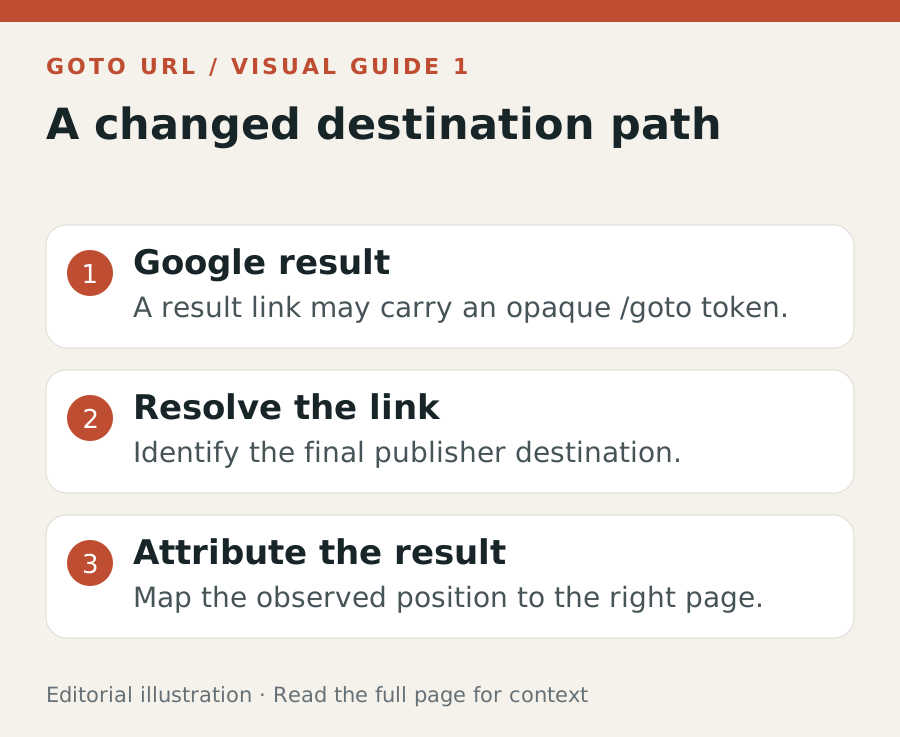
Google changed the delivery layer, not the ranking evidence
During testing in July 2026 and a wider rollout in August, Google began replacing direct destination links in some Search results with a server-side google.com/goto redirect. Observations indicate broad organic-result coverage, but implementation can vary by location, account state, device and result type.
Google can now place an opaque, server-side /goto address between a Search result and its destination. A person still selects the same result and should reach the same publisher.
The material change is for software reading Search at scale. A tool may see a Google-owned intermediary where it previously saw the final page URL, so it must resolve and validate the destination before using it.
Resolve a link, fix an error or check your tracking
A Google GoTo URL is an intermediary such as google.com/goto?url=CAES… behind a Search result. The displayed result can look familiar while its clickable address no longer exposes the publisher directly. Choose the guide that matches the problem you need to solve.
Senuto: directional data still needs quality evidence
Senuto’s CEO discusses collection disruption and continuing the service. This is not an announcement that rank tracking is ending. CEO statement · 14 October 2026 (Polish).
Our assessment: a directional trend can still be biased by collection failures. Check freshness, successful collection, depth and destination quality separately; do not attribute every anomaly to /goto. Read the Senuto review and evidence assessment, Polish review and international tracker directory.
What the redirect changes in the data chain
The visible result can still show the publisher’s name and familiar display URL while the clickable anchor points to Google. One recovery route is to request the intermediary and inspect its redirect response. Some providers also report recovering destinations from embedded result-page data; that depends on the actual markup and verified URL pairing.
publisher.co.uk/reviewOne parsed result already contains the page-level destination.
google.com/goto?url=[opaque]The collector needs another resolution step before it can attribute the result.
- 1Google renders the result.
The visible title, snippet and displayed domain can still look normal to a person.
- 2The anchor points at Google.
The underlying link can contain an opaque token rather than the final publisher URL.
- 3Google resolves the destination.
A genuine click passes through Google’s endpoint and continues to the publisher.
- 4Automation needs a resolution method.
A collector may need extra requests or an adapted extraction method. The cost depends on its recovery path, duplicate handling and result coverage; it is not a universal one-request-per-result rule.
That distinction is small for one human click and potentially large for a service collecting thousands or millions of result links.
OpenWeb Ninja’s original page-data tests report an alternative to requesting each wrapper. These observations qualify the recovery options; they do not establish a permanent Google interface.
What Google says, and what can reasonably be inferred
Google has framed the rollout as part of its continuing technical response to abuse. That supports an anti-automation interpretation, but it does not establish every commercial or strategic motive attributed to the company.
The architecture plainly adds friction to bulk destination extraction. It may also give Google more control over how result clicks are routed, but the existence of a redirect does not by itself prove a new tracking programme or a change to ranking systems.
- CONFIRMEDGoogle is rolling out the redirect and describes it as an anti-abuse measure.
- SUPPORTED INFERENCEBulk SERP collectors need new logic or an upstream supplier that resolves the links.
- NOT ESTABLISHEDThe change alters rankings, indexing, canonical selection or ordinary website URLs.
Four different exposure profiles
Searchers
A normal click should still reach the selected publisher. The extra hop is mostly hidden unless it fails, slows down or changes browser-visible behaviour.
Publishers
Rankings and indexed URLs are not shown to change. Publishers should watch referral classification, landing-page analytics and unexplained differences between analytics and Search Console.
SEO data vendors
Products that need the final URL may have to resolve one intermediary per result. At scale, that can increase requests, latency, failure handling and collection cost.
AI and research systems
Systems that use Google results as a discovery layer can face the same resolution problem. Systems using their own crawl, licensed feeds or other engines do not inherit it automatically.
The statements differ sharply in what they prove
The clearest responses acknowledge that adaptation was needed. SerpApi first named affected APIs and later said its fix was deployed. SISTRIX says resolution adds one request per URL; after an initial slowdown it reported normal cycles on 1 September. Monitorank said it would follow every redirect while testing whether its infrastructure could bear the load.
Semrush and SE Ranking say customers were unaffected. SE Ranking gives one useful implementation constraint — it says it recovers the destination without activating the redirect — while Semrush does not disclose a method, coverage measure or benchmark. Its assurance supports no customer-visible impact; it cannot establish that internal systems, cost and engineering effort were literally untouched.
DataForSEO published its own feature-level unresolved-SERP rates, then said direct URLs had been restored across the affected elements.
Ahrefs described temporary data inconsistency. No later provider-owned resolution notice was located by 13 September.
Most providers publish neither a /goto response nor the data-source architecture needed to assess an unaffected claim.
DataForSEO’s initial snapshot is still useful as evidence that exposure varied by result type, not as a current market-wide failure rate:
These provider-reported figures measure whether a returned SERP contained at least one unresolved URL before DataForSEO’s 28 August update. They are not individual-link failure rates, do not predict another provider’s performance and were not independently audited.
What an independent resource should keep testing
- Will Google keep the same redirect behaviour across organic results, AI Overviews, featured snippets, local packs and signed-in searches?
- What request patterns trigger rate limits or additional verification when a service resolves large numbers of destination links?
- Will referral and attribution behaviour remain consistent across browsers, privacy settings, devices and markets?
- Will Google document the mechanism beyond its general statement about preventing evolving abuse?
- Which vendors resolve destinations themselves, and which depend on an upstream data supplier to do it?
How to separate a data problem from an SEO problem
- 1Compare the tool with a manual search.
Check the same query, country, location and device as closely as possible.
- 2Check Google Search Console.
First-party impressions, clicks and average position provide a separate signal from a third-party collector.
- 3Inspect the reported landing page.
A blank, Google-owned or suddenly reassigned URL can indicate resolution failure rather than genuine ranking movement.
- 4Look for a provider statement.
Prefer a dated technical notice over assumptions based on one anomalous dashboard.
Google’s collection changes are different problems
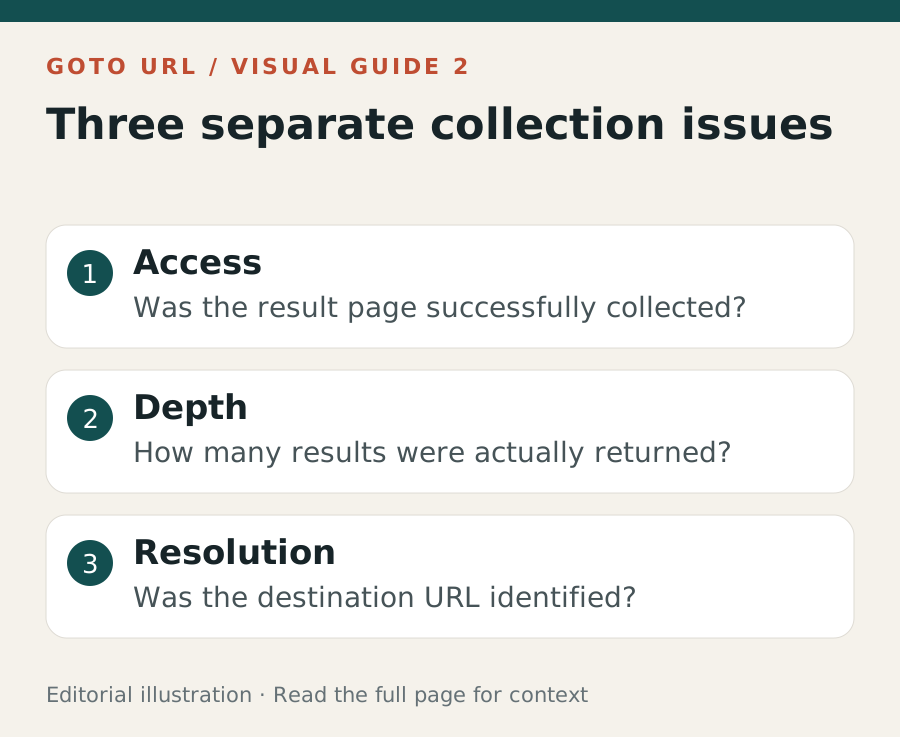
SEO Stack’s critique usefully separates a narrow keyword report from a site’s wider search performance. The lesson is to broaden measurement, while keeping the collection failure mode clear. Read the critique; our review assesses its conclusions and caveats.
- Result depth: num=100
- The September 2025 change disrupted retrieving many results in one request. Ahrefs subsequently reported restoring top-100 collection, with some fallback cases. This is evidence of adaptation, not proof that deep tracking ended or that every provider now needs exactly ten requests. Ahrefs’ dated updates.
- Destination extraction: /goto
- A collected result can carry an intermediary instead of its destination. DataForSEO documents mitigation and a reported 99.99% organic-SERP resolution rate at its update. That figure is supplier-specific and measures returned SERPs, not individual links or every result feature. DataForSEO’s resolution notice.
- Access restrictions
- Google’s machine-generated traffic policy explicitly includes unauthorised automated rank-check scraping. This supports an access-friction assessment, but neither establishes every motive behind /goto nor shows that a customer’s website receives a ranking penalty for using a tracker. Google’s policy.
A missing result is not a measured ranking loss
If a dashboard changes, identify whether the query was checked, how deep the check reached and whether its landing URL was resolved. Preserve the timestamp and collection status. A blank URL, incomplete result set or failed refresh is a different observation from a successful check that no longer contains your page.
For supplier evaluation, request a matched keyword/location/device sample, unresolved-result rates, depth and refresh completion, then ask about actual customer quota or price changes. Extra engineering work is plausible; a price increase or specific cost multiplier requires provider evidence.
Report a fixed watchlist and the wider footprint
A fixed commercial watchlist helps answer whether priority terms improved. Available query breadth helps discover new exposure. Read both alongside relevant clicks, landing-page engagement and qualified leads: more low-value queries can coexist with weaker commercial performance. Compare like-for-like cohorts before attributing a blended average change to SEO work.
First-party data can have its own discontinuities
Google’s anomaly record identifies an impressions logging error from 13 May 2025 to 27 April 2026, also affecting CTR and average position but not clicks. Annotate that period when comparing stored history. It is a reporting issue, distinct from a ranking loss or a SERP collector outage. Google’s official anomaly record.
Search Console provides a different collection path

A workflow based on Search Console performance data does not need to extract live Google result links to report its own-property clicks, impressions and average position. Architecturally, that avoids the redirect-resolution step described above. It is a feature-level distinction, not a guarantee about every module in a platform.
GSC averages are not a like-for-like replacement for city-specific, competitor or continuous top-100 rank checks. Google records position only when an impression occurs, withholds some queries and limits API extraction. The separate num=100 depth change should not be conflated with GoTo URL redirects.
Our full SEO Stack review explains the useful perspective and its limits. For a tool anomaly, compare matched query, country, device and date segments; inspect the ranking page and clicks before concluding either an SEO loss or a collector failure.
Quick answers to related GoTo URL searches
What does “go to URL” mean?
In general browser instructions, it means navigate to a web address. In this Google update, /goto is a specific Google-owned redirect path. GoToURL.co.uk is an independent publication, separate from that endpoint.
How do I find the real URL behind a CAES link?
Use the step-by-step resolver guide, including curl and Python examples. A copied opaque token is not a readable publisher address.
Why do copied Google links stop working?
Identify whether the error occurs at Google or the publisher, then compare a freshly copied result. Our troubleshooting guide covers incomplete tokens, request-method differences and browser restrictions.
Does /goto mean my rankings have dropped?
A changed link format alone does not demonstrate a ranking loss. Check collection success, depth and destination resolution using the rank-tracking checklist.
The practical guides were reviewed on 18 October 2026. Provider response assessments below retain their original review dates and are not a new accuracy benchmark.