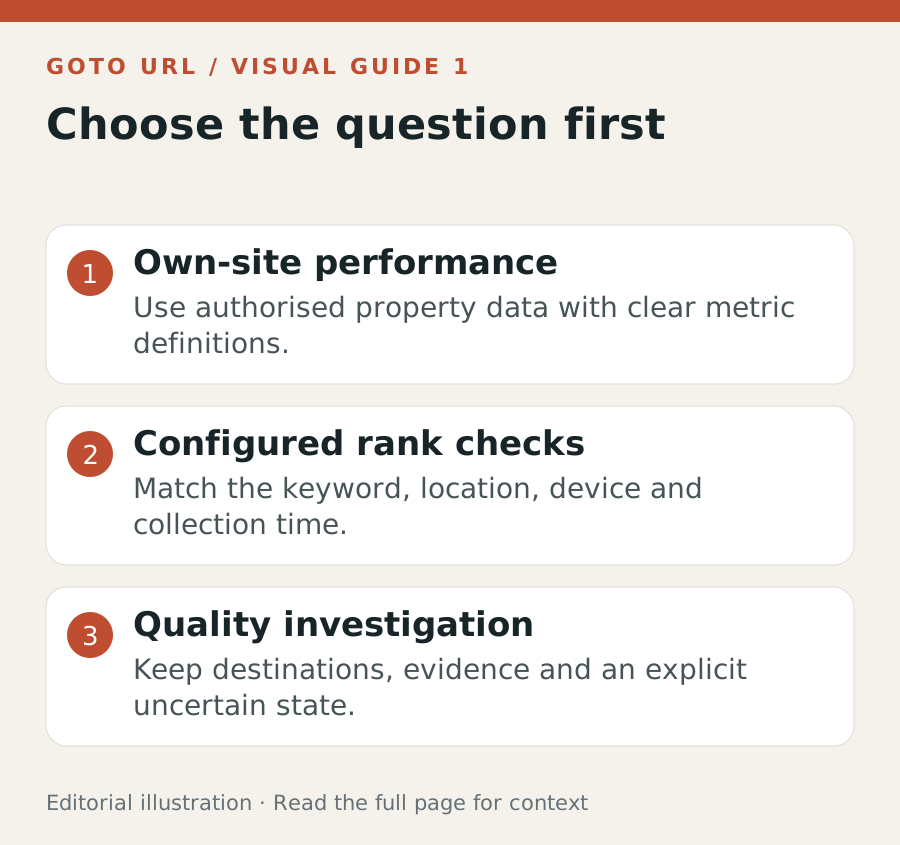
Choose the question before choosing the alternative
“Where do we rank?” can mean the position of your page in one configured search, the average position recorded when users saw your site, or the extent to which an AI answer cites your brand. Those are different measurements. A replacement should answer the question you actually need, rather than reproduce a familiar dashboard.
A standard tracker normally packages collection, history, alerts and reporting. Building an API dashboard replaces the packaging and supplier relationship; it does not automatically create an independent data source. A custom browser collector takes responsibility for more of that dependency.
| Requirement | Practical starting point | Main limitation |
|---|---|---|
| Own-site search performance | Search Console plus landing-page and conversion reporting | Impression-based averages; not a controlled competitor or city-specific ranking check. |
| Fixed keywords and competitor positions | Managed SERP API with stored history and quality checks | Still dependent on third-party Google collection. |
| Investigate a suspicious movement | Supervised browser observation with matched settings | A sample, not proof of all users’ results or a scalable unattended service. |
| Sell a differentiated monitoring product | Hybrid reporting: API collection, sampled corroboration and evidence | Requires commercial rights, validation and ongoing operations. |
| Own the collection infrastructure | Custom browser workers and parsing pipeline | Largest engineering commitment; continued Google access remains uncertain. |
Why the alternatives are being discussed
Recent problems concern several stages: obtaining the results page, retrieving enough results, discovering the publisher destination behind an opaque link and deciding whether the returned set is representative. Our historical timeline separates those developments; the 30 October report covers the latest destination-resolution delays.
Google’s own Search Traffic Integrity recruitment material describes work on scraper detection and countermeasures. It does not establish a newly created department with a declared mission to eliminate every named rank tracker. Nor do repeated changes establish a fixed weekly release schedule or prove that useful rank tracking must end.
Evidence: Google: Search Traffic Integrity Engineering Analyst ↗
There is a logical problem with claiming that all third-party rank tracking is doomed while recommending a different third-party scraping service as a permanent solution. That supplier still depends on access and collection quality. Evaluate its current output and recovery process rather than the certainty of its marketing.
Five practical alternatives and their trade-offs
1. Search Console-led performance monitoring
Google’s Search Analytics API supports authorised access to own-property performance data, grouped by dimensions such as query, page, country and device. Its documentation warns that it does not guarantee every row. Average position is an impression-based measure, not a scheduled neutral search from a specified city.
Evidence: Google: Search Analytics API ↗ · Google: impressions, clicks and position definitions ↗
This is a useful foundation for an owner asking which pages gain clicks and enquiries. It avoids extracting live result destinations for that own-property workflow. It cannot supply a complete competitor result set, prove a fixed local rank or explain every unreported query. Retain available history, segment comparisons consistently and connect landing-page outcomes separately.
2. A managed SERP API feeding your own dashboard
Buy collection as an input and own the scheduled keyword list, history, reporting and customer experience. This is usually the smallest engineering step towards a tailored monitoring service. The provider table below identifies candidates, not a tested quality ranking.
Use a documented adapter for each supplier so that your application does not depend on one response schema. Store the original response where permitted, alongside normalised records. An HTTP success code should not alone qualify a check as complete or accurate.
3. Supervised browser checks, including Claude Code
Anthropic documents Claude Code controlling visible Chrome, sharing its login state and extracting page data. Its instructions say it pauses when a login page or CAPTCHA needs manual handling. That supports supervised research; it does not demonstrate an uninterrupted commercial collector.
Evidence: Anthropic: Claude Code with Chrome ↗
For investigations, preserve the query, device, time, requested location and session context. A personal browser can have account history and a location unlike the target market. A screenshot is useful evidence of what that session displayed, not a universal ground truth. Using an AI assistant for every routine check also introduces model usage and another source of operational variability.
4. A custom browser collection pipeline
Hosted browser services can supply sessions and network routing. Your software must still organise jobs, interpret results, preserve evidence, handle failures, control spending and validate outputs. Network location and Google’s displayed search location should be recorded separately where available.
Residential routing does not turn automated activity into human activity. Location targeting also needs checking: Browserbase documents best-effort geography and possible fallback to a nearby location. A nominal city setting should not silently become a verified city observation.
Evidence: Browserbase: proxy location and fallback behaviour ↗
A website backend can call hosted browser services over HTTP; running the browser itself is a separate infrastructure concern. Self-hosting gives more control over the runtime but adds provisioning, updates, concurrency management and maintenance. This guide does not claim a universal method for defeating Google’s protections.
5. A hybrid monitoring and verification service
Use a managed API for routine observations and a second permitted source or supervised sample to investigate anomalies. Add Search Console evidence for customer properties and keep the metrics separate. Classify missing, stale, incomplete and disputed observations before generating alerts.
This is our preferred starting point for a small commercial product. Its value comes from understandable evidence and responsive investigation. Two providers agreeing is supporting evidence, not proof: they could share upstream infrastructure or encounter the same restriction. Provider diversity should be investigated rather than assumed.
Services to investigate and their indicative prices
Prices below are public figures in US dollars, checked 31 October 2026. Units differ: a request, a page, a result, a browser hour and a credit are not interchangeable. Taxes, overages, commercial licences and additional features may change the bill. Follow the linked pricing pages before purchasing.
| Service | Published price example | What you buy / what to verify |
|---|---|---|
| Cloro | Lite $30/month; Hobby $100/month; Starter $250/month. | Structured Google and AI-search outputs. Check credit costs, destination coverage and commercial-use terms. |
| Bright Data | SERP API pay as you go: $1.50 per 1,000 requests. | Managed collection with parsed output options. Test the chosen result types and locations. |
| Oxylabs | Google JS: $1.35 per 1,000 results at lower tiers; plan minimums apply. | Managed Google extraction. Verify the exact product, billable result and rendered output. |
| SearchApi | Developer: $40/month for 10,000 searches. | Structured search data. Confirm feature coverage and the definition of a chargeable success. |
| Serper | Starter: $50 top-up for 50,000 credits; six-month validity. | Google search data. A low price is a useful cost reference, not evidence of accuracy. |
| Browserbase | Developer: $20/month, including 100 browser hours and 1 GB of proxy usage; overages apply. | Browser infrastructure. Extraction, validation and the report layer remain your work. |
| Browserless | Prototyping displayed at $25/month billed annually; browser time and proxy traffic consume units. | Browser infrastructure. Annual equivalent is not monthly billing; model session length and bandwidth. |
Evidence: Cloro: published pricing ↗ · Bright Data: SERP pricing ↗ · Bright Data: SERP API capabilities ↗ · Oxylabs: /Scrape and Google JS pricing ↗ · Oxylabs: Google Search collection ↗ · SearchApi: plans and billing ↗ · Serper: features and credit pricing ↗ · Browserbase: browser and proxy pricing ↗ · Browserless: plans and usage units ↗
Do not exclude established suppliers such as DataForSEO or SerpApi simply because a newer service claims a different approach. An existing contract, usable history and proven support can matter. Compare the actual module and a matched sample before migrating. Our tool comparison directory provides wider product context.
What about an official Google search API?
Google’s Custom Search JSON API is closed to new customers and its notice gives existing customers until 1 January 2027 to transition. It is a Programmable Search Engine product, not a like-for-like representation of every Google consumer results page. It is therefore not a dependable new foundation for this proposed rank-tracking product.
Evidence: Google: Custom Search JSON API transition notice ↗
Cloro: a promising candidate with limitations to resolve
Cloro documents structured Google results, location and device parameters, optional AI Overview collection and pagination. Its MCP integration gives assistants access to its hosted tools; the assistant is not thereby controlling the customer’s personal Chrome. Cloro recommends its asynchronous API for bulk collection rather than conversational MCP calls.
Evidence: Cloro: Google SERP API ↗ · Cloro: MCP integration and bulk-use limitations ↗
Destination recovery is different from ranking accuracy
Cloro’s 30 October account reports recovered external links separately from result-set quality. Its “full page” rule checks for at least three usual sites in the top five; that does not validate every exact URL and position. Its own divergent-results report also records substantial disruption. These are supplier-run measurements and proposed explanations, not our independently reproduced benchmark.
Evidence: Ricardo Batista / Cloro: 30 October redirect report ↗ · Cloro: divergent-results study, updated 29 October ↗
Ask for a matched sample, original evidence where available, the timestamp, the actual market and an explanation of what happens when a check fails. Historical reference queries can detect anomalies, but a baseline can also become outdated after a genuine ranking change. Detection needs corroboration and an “uncertain” state, not automatic rejection of every unfamiliar result.
Commercial and benchmarking rights need written clarity
Cloro’s standard terms restrict third-party availability, resale, competing-product use and benchmarking. Its agency guidance nevertheless promotes white-label reporting. An enterprise order form may change the applicable rights; do not infer permission for a paid service from marketing alone. Ask for explicit coverage of collection, evaluation, derived reports, customer access and retention.
The terms’ availability commitment excludes target-site changes and anti-scraping measures. Infrastructure uptime therefore should not be presented as a guarantee of correct, current ranking observations.
Evidence: Cloro: terms, sections 1.1, 1.5 and 2.3 ↗ · Cloro: white-label agency guidance ↗
Our conclusion is to shortlist Cloro, subject to those questions and a permitted evaluation. We have not verified its internal browser implementation or run authenticated performance tests. Its public examples demonstrate an interface, not the quality of a future customer’s production workload.
What a workable system would contain
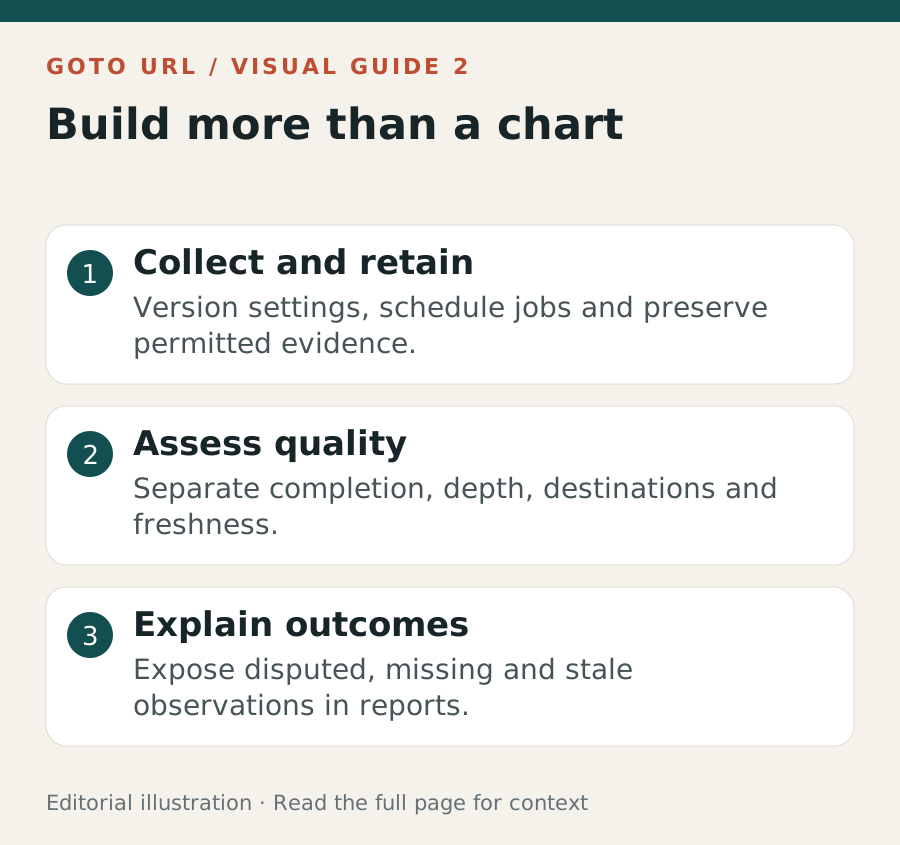
A minimum product needs more than a keyword input and a chart. The implementation should preserve enough context to explain a result, control spending and recover from interruption.
| Component | Responsibilities | Evidence retained |
|---|---|---|
| Project configuration | Keywords, domains, intended location, language, device, schedule, result types and depth. | Versioned settings and effective dates so a changed configuration does not silently rewrite history. |
| Scheduler and job queue | Create bounded jobs, enforce quotas, resume interrupted work and avoid duplicate billing. | Scheduled time, attempt identifier, provider and collection status. |
| Supplier adapters | Translate requests and responses while preserving supplier-specific fields. | Source, actual collection time, raw response where licensed and parser version. |
| Quality assessment | Check completeness, destinations, freshness, context and material anomalies. | Reasons for flags and any corroborating observation; never label agreement as certainty. |
| History and evidence storage | Separate tenants, apply retention and allow permitted exports. | Observed ranking URL, position definition, page depth and accessible evidence. |
| Reports and alerts | Separate checked absence from failed collection; surface stale values and investigate changes. | The observation behind each displayed point and alert. |
| Operations and billing | Spend caps, usage metering, permissions, offboarding, monitoring and support. | Auditable customer usage and service incidents. |
For a small service, start with one engine and market, a controlled keyword list and one defined organic-position metric. Add mobile, local-pack positions and AI citations only when their different meanings and validation requirements are supported. Country-level organic checks are not a substitute for a local rank grid.
Indicative build costs: prototype to commercial product
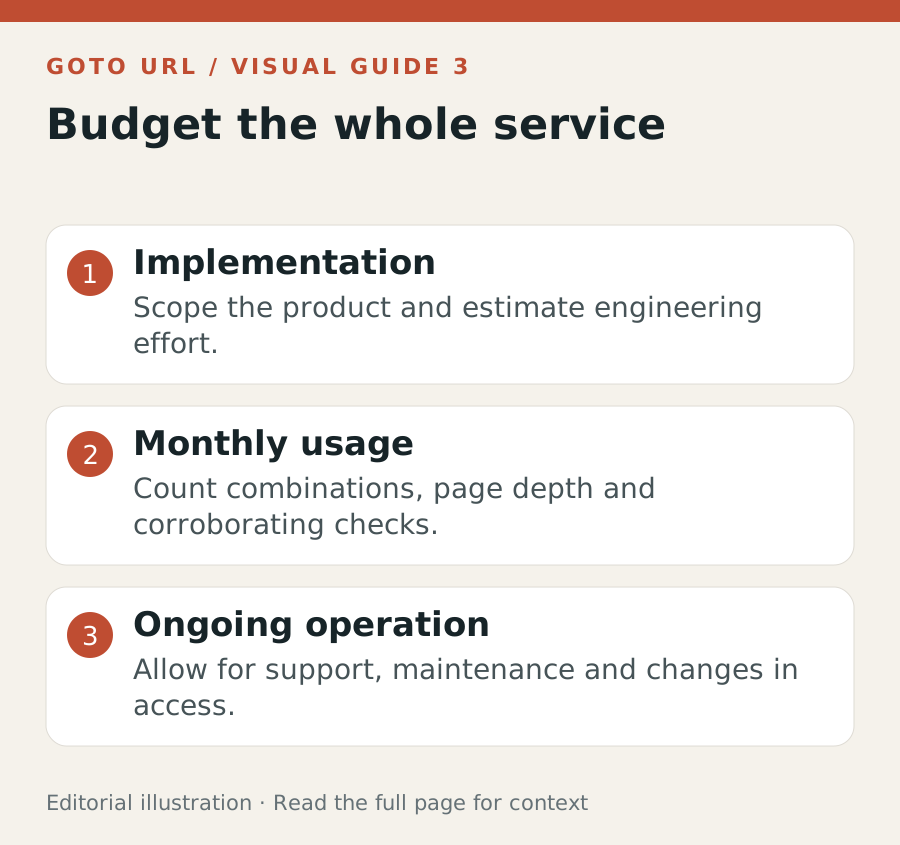
Estimate method: the model below assumes an engineering day rate of £500–£800, selected as a planning assumption. It is not a researched market average. The lower bound multiplies the minimum days by £500; the upper bound multiplies the maximum days by £800. Figures exclude VAT, supplier bills and the exclusions below.
Days mean total person-days of delivery effort, including implementation, testing and basic documentation. They are not promised elapsed delivery times. Procurement, account approval, evaluation periods and external reviews can extend the calendar. The scenarios are alternative total scopes, not rows to add together.
| Scope | Engineering effort | Indicative build budget | What the estimate covers |
|---|---|---|---|
| Private proof of concept | 2–5 person-days | £1,000–£4,000 | One provider, one market, a fixed query list, CSV output and manual sample checks. No customer billing or service guarantee. |
| Internal monitoring tool | 8–15 person-days | £4,000–£12,000 | Scheduled jobs, stored history, a small dashboard, failed-check status and basic anomaly review. An internal tool, not a public multi-customer service. |
| Paid service using managed APIs | 25–50 person-days | £12,500–£40,000 | Customer accounts, tenant separation, quotas, billing integration, two supplier adapters, evidence records, quality flags, exports and operational controls. |
| Product with its own browser collection | 60–150 person-days | £30,000–£120,000 | Customer product plus browser orchestration, parsing, location controls, collection diagnostics and a monitored validation pipeline. Continuing access and perfect accuracy are not guaranteed. |
Contingency: allow a further 20–30% if the brief is not fully specified. For example, the managed-API paid-service model becomes about £15,000–£52,000 when the lower end receives 20% and the upper end 30%. That is a risk allowance, not a claim that every project will need it.
Why an AI-assisted prototype can cost less than a product
An owner who writes or reviews code with an AI assistant may spend much less cash on a prototype than the equivalent outsourced estimate. That does not remove the owner’s time, provider subscriptions, independent validation or maintenance. Authentication, billing, customer isolation and trustworthy history are usually where an experiment becomes a larger commitment.
A full custom collector is an ongoing engineering programme. The larger range above allows for browser orchestration and investigation, but it does not buy permanent access or an ability to overcome every future restriction. A clear stopping rule is needed if usable data cannot be maintained economically.
What is excluded
- Legal advice, negotiated data licences, tax advice and any associated agreements.
- Formal penetration testing, external security audits, enterprise procurement and certifications.
- Sales, customer acquisition, content production, migration of unlicensed historical datasets and extensive training.
- Guaranteed round-the-clock response, an enterprise accuracy SLA or coverage of every country and Google feature.
- Major bespoke integrations, complex permissions, unlimited evidence retention or unusually high concurrency.
For a scoped quotation, specify customers, keywords, markets, devices, cadence, depth, retention, response expectations and the evidence required. Quoting a build without these inputs gives a false impression of precision.
Monthly running costs: count combinations and service obligations
Start with the workload:
Monthly primary checks = keywords × locations × devices × runs per month
Then add requested pages or depth, sampled repeat checks, any second-provider calls, optional AI outputs and evidence retention. Keep a primary check separate from a page request and a result URL. Some suppliers package these differently.
Worked Cloro data examples
For the asynchronous public model used here, the first Google Search page costs three credits and each additional page two. The table assumes 30 daily runs, no additional checks and enough credits on the smallest listed paid plan. It prices calls, not a guaranteed number of valid rankings.
| Configuration | Primary checks | Credits | Listed plan covering the model |
|---|---|---|---|
| 100 keywords; one location; one device; one page | 3,000 | 9,000 | Lite: $30/month |
| 1,000 keywords; one location; one device; one page | 30,000 | 90,000 | Hobby: $100/month |
| 1,000 keywords; three locations; two devices; one page | 180,000 | 540,000 | Starter: $250/month |
| 1,000 keywords; one location; one device; ten pages | 30,000 | 630,000 | Starter: $250/month |
Evidence: Cloro: published pricing ↗
The ten-page example requires 21 credits per check, not three. Adding 10% repeat checks raises its requirement to 693,000 credits and crosses the model’s Starter allowance. A target depth is also not a promise that Google will provide exactly that many organic results. Commercial-use pricing could differ from the public subscription.
Compare actual spend, not just an advertised unit rate
On Bright Data’s listed $1.50 per thousand request rate, 30,000 billable requests would be $45. That comparison is only meaningful if one request delivers the same required scope and usable output. Serper’s $50 top-up buys a larger block with an expiry; it is a different purchasing pattern from a monthly subscription. Plan minimums and unused credits can outweigh a low nominal rate.
Evidence: Bright Data: SERP pricing ↗ · Serper: features and credit pricing ↗
What operating browsers yourself might cost
Here is a sensitivity example using Browserbase’s published Developer allowances. Assume 30,000 browser checks a month, 20 seconds of occupied browser time per check, and 1 MB of billable proxy traffic per check. Those duration and bandwidth inputs are illustrative assumptions, not measurements of Google.
The workload is about 166.7 browser hours and 30 GB of traffic using decimal GB. With the listed $20 base, 100 included browser hours, 1 GB of included proxy traffic, then $0.12 per extra browser hour and $12 per extra GB, the illustrative bill is about $376/month: $20 base + $8 time + $348 traffic.
At the same browser duration but 0.5–2 MB per check, that model spans roughly $196–$736/month. Retries, longer verification waits, other billable assets and different traffic accounting can change it materially. Measure real usage before projecting scale. These figures exclude models, storage, support and engineering.
Evidence: Browserbase: browser and proxy pricing ↗
Maintenance and support can exceed the data bill
| Operating model | Maintenance effort assumption | Labour at £500–£800/day | Other budget lines |
|---|---|---|---|
| Small internal API tool | 1–2 days/month | £500–£1,600/month | Allow approximately £10–£75/month for modest hosting, storage and monitoring; usage can exceed this. |
| Paid managed-API service | 2–5 days/month | £1,000–£4,000/month | Allow approximately £50–£300/month for an early-stage application stack, plus data, customer support and payment fees. |
| Own browser collection product | 5–15 days/month | £2,500–£12,000/month | Browser compute, bandwidth, logs, evidence storage and incident coverage are additional. |
These are illustrative budgeting allowances, not minimum invoices or vendor tariffs. An owner can absorb some labour personally; a demanding SLA can require substantially more. Budget incident work even in a month when usage is low.
Interactive monthly data-cost calculator
Change the inputs to see how market coverage, device count, page depth and extra checks affect a public-plan budget. This calculates an example supplier subscription; it does not calculate the total cost of owning the product.
ILLUSTRATIVE CLORO DATA BUDGET
Calculate the checks before choosing a plan
30,000 primary checks + 3,000 extra checks = 33,000 monthly calls.
3 credits per call; 99,000 credits in total.
$100/month on the smallest listed plan covering this model: Hobby (250,000 credits).
A validation plan before committing to a supplier or selling the service
First establish permission for the planned evaluation, especially where terms restrict benchmarking or competing-product use. Then use a fixed, representative sample over at least two weeks. This is a proposed evaluation design, not a study we have already conducted.
- Define the target observation. Specify country or city, language, device, logged-out or other session conditions, result type and the rule for counting position. A local pack and organic results need separate rules.
- Include realistic queries. Mix brand, commercial, local and informational terms. A panel of unusually stable reference searches alone can overstate performance on customer workloads.
- Compare close in time. Keep timestamps, configured context and actual returned destinations. Inspect selected observations in an appropriately located supervised browser session.
- Measure quality separately. Report collection completion, freshness, actual depth, destination resolution, exact-URL agreement and rank differences. Do not average all of these into an unexplained success score.
- Keep disagreements. Label the case uncertain and investigate. A genuine ranking change, personalisation, geography and a collection anomaly can look similar.
- Calculate cost per usable observation. Divide total supplier spend by observations that meet the agreed requirements, including the cost of checks used to assess quality.
- Set an acceptance rule before viewing the results. For example, propose at least 95% completed scheduled checks within the promised window and separately report URL and position agreement. This is a candidate product target, not an industry benchmark or present supplier performance claim.
Use a human-reviewed sample to assess false alarms as well as missed anomalies. A detector that merely rejects every surprising page can hide real changes. A provider-independent evidence trail is more useful than a confidence percentage with no disclosed meaning.
Commercial rights and the promise made to customers
Google’s machine-generated traffic policy expressly includes automated rank-check scraping without permission. Browser choice and proxy routing do not, by themselves, change that classification. The relevant contracts and intended commercial use need review; this guide does not offer a legal conclusion about a particular implementation.
Evidence: Google: machine-generated traffic policy ↗
Ask a supplier whether the agreement covers a customer-facing dashboard, derived metrics, exports, evidence storage, commercial comparisons and termination. Confirm what happens if its upstream access changes. Avoid describing the product as permanently unblockable or independently verified unless the evidence supports that exact scope.
A practical customer promise could be scheduled observations with explicit freshness and quality status, an accessible history and investigation of material anomalies. If collection fails, show that status. Do not record “not found in a completed check” and “not successfully checked” as the same result.
Our recommended build sequence
Start with a private, limited prototype using a permitted managed feed. Collect a representative sample, retain the outputs and verify whether it solves a real reporting problem. If it does, add history, monitoring and a second supplier adapter before investing in a public service.
For GoTo URL, the most defensible initial proposition is a monitoring and investigation layer with evidence behind its reports. That complements the site’s explanation of changing Google collection methods. A low-price wrapper with an absolute accuracy promise would be much harder to defend.
Only fund independent browser collection when there is a demonstrated coverage gap, suitable permissions, measured unit economics and engineering capacity to maintain it. The saving on API bills alone may not cover the continuing work. Where an existing tracker already meets the requirement at a lower total cost, keeping it is a reasonable outcome.
Frequently asked questions
Can I build this with Claude Code rather than hire a developer?
You can use a coding assistant to create and maintain a prototype, particularly if you can review the code and validate the output. That can lower cash expenditure. It does not remove the need to test numbers, protect customer data, control usage and operate the service. A working demo is not the same scope as the paid product budget above.
Does using real Chrome make the results accurate?
It records what a particular session receives. Accuracy still depends on the intended context, the page delivered, how positions are counted and whether destinations are recovered. Browser-based observations are useful evidence, with explicit limits.
Is Search Console a free replacement for every rank tracker?
It is an important own-property source, but its average-position and query data answer different questions from configured competitor rank checks. Software to ingest, preserve and report it also has an implementation and operating cost.
Is Cloro a replacement for Ahrefs or Semrush?
A data API can support a custom ranking or AI-visibility workflow. It does not automatically replace every suite function, dataset, historical report or user interface. Compare the actual functions your team uses.
What would a small paid product cost to build?
Under this guide’s assumed day rate and scope, a managed-API paid MVP is £12,500–£40,000 before contingency, VAT and running costs. A much smaller private prototype is £1,000–£4,000 in equivalent outsourced effort. These are planning ranges, not quotes.
Have these providers been independently tested for this guide?
No. We reviewed public product material, pricing, terms and attributed reports. No authenticated supplier benchmark, paid account trial or live Google-token experiment was performed for this page. The calculator models listed prices, not measured service performance.
Sources, dates and estimate limits
Research and prices checked 31 October 2026. Supplier pages and status can change. External technical and operational claims remain attributed; our budgets, build sequence and suggested acceptance criteria are editorial planning models.
- Google: Search Analytics API ↗
- Google: impressions, clicks and position definitions ↗
- Google: machine-generated traffic policy ↗
- Google: Search Traffic Integrity Engineering Analyst ↗
- Cloro: Google SERP API ↗
- Cloro: published pricing ↗
- Ricardo Batista / Cloro: 30 October redirect report ↗
- Cloro: divergent-results study, updated 29 October ↗
- Cloro: terms, sections 1.1, 1.5 and 2.3 ↗
- Cloro: white-label agency guidance ↗
- Cloro: MCP integration and bulk-use limitations ↗
- Bright Data: SERP API capabilities ↗
- Bright Data: SERP pricing ↗
- Oxylabs: Google Search collection ↗
- Oxylabs: /Scrape and Google JS pricing ↗
- SearchApi: plans and billing ↗
- Serper: features and credit pricing ↗
- Browserbase: browser and proxy pricing ↗
- Browserbase: proxy location and fallback behaviour ↗
- Browserless: plans and usage units ↗
- Anthropic: Claude Code with Chrome ↗
- Google: Custom Search JSON API transition notice ↗
No supplier quotation, resale approval, legal review or independent accuracy audit is implied. USD costs are left in their original currency; GBP estimates are not currency conversions.