What is new?
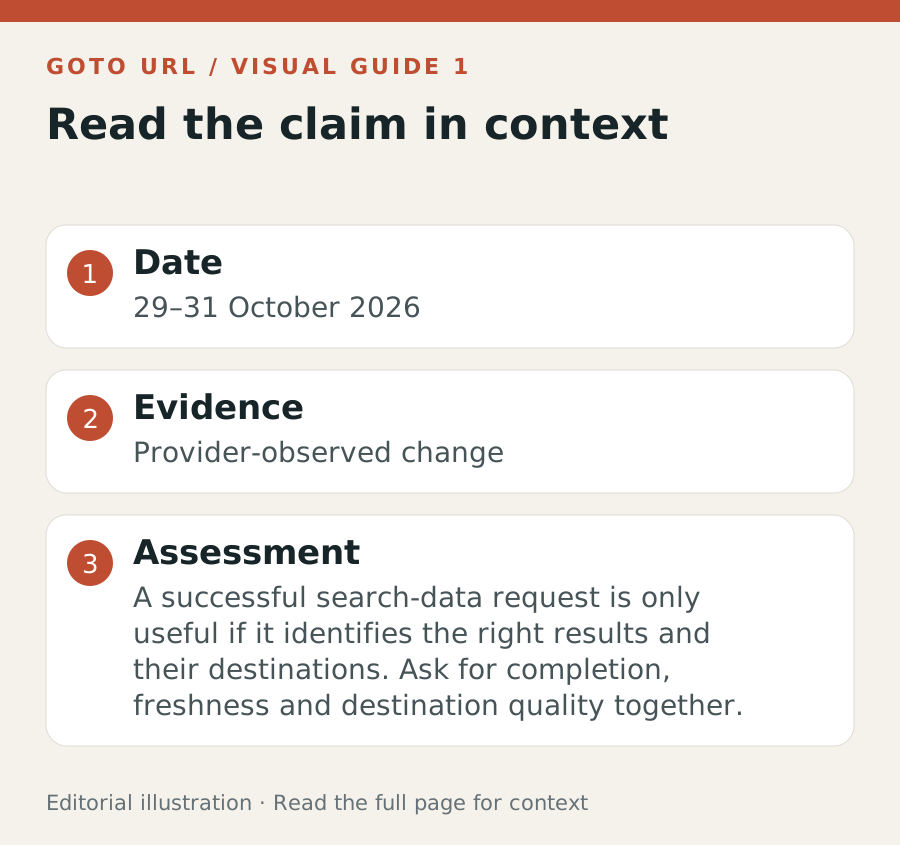
The issue occurs after a results page has been collected. Some result links point to a Google intermediary; resolving them reveals the publisher destination. Providers now report a verification pause at that stage. PrismCrawl describes this behaviour on 30 October. This is an additional obstacle to extracting destinations, rather than the original introduction of /goto.
Evidence: PrismCrawl: /goto verification delays ↗
Who is reporting what?
SERP Lens says roughly the first six or seven destination lookups per results page were immediate in its tests, with increasing waits after that. Its update describes prioritising top organic results and waiting for remaining links. Brodie Clark also flagged that earlier workarounds had stopped working. These are observations from that tool, not a Google specification.
Ricardo Batista of Cloro reports waits of around 60–115 seconds in its production traffic, beginning more broadly on 30 October. It also claims a faster alternative route restored destination delivery on its reference queries. The differing timings matter: they do not establish one threshold that applies to every session or client.
SerpApi opened an unresolved-link incident at 10:39 UTC on 30 October. Staff comments in issue #4315 describe reproducing the problem and customer production impact. That corroborates destination-delivery disruption, but does not independently validate another vendor’s benchmark or proposed mechanism.
Evidence: SERP Lens update, visible on Brodie Clark’s LinkedIn profile ↗ · Ricardo Batista, Cloro: what broke on 30 October ↗ · SerpApi: unresolved /goto links incident ↗ · SerpApi public issue #4315 ↗
Our viewpoint: adaptation is possible, but promises need dates
Our assessment is that this raises the cost of obtaining usable observations. A tracker may still collect a title and position while failing to identify the exact page. Treating that as a fully successful check would hide the weakness from the customer.
The reports do not support declaring rank tracking finished. Providers describe mitigations, and implementations can differ. Equally, an earlier statement that a provider solved /goto cannot establish that it handles a later variation. A useful claim needs a date, result types, market coverage, a completion rate and a definition of success.
Cloro sells a competing service. Its comparative results are useful as a disclosed test, but we have not reproduced them and do not use them to rank suppliers here. SERP Lens’s smaller delays and Cloro’s longer waits could reflect different request conditions; the published evidence does not settle the reason.
What website owners and agencies should check
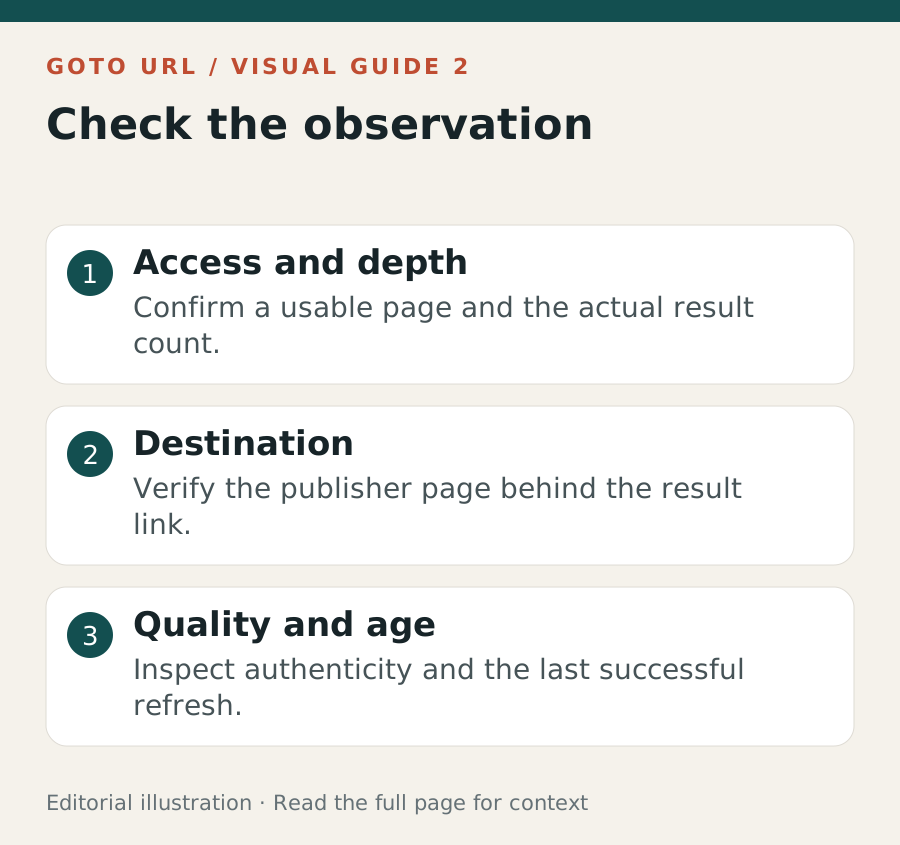
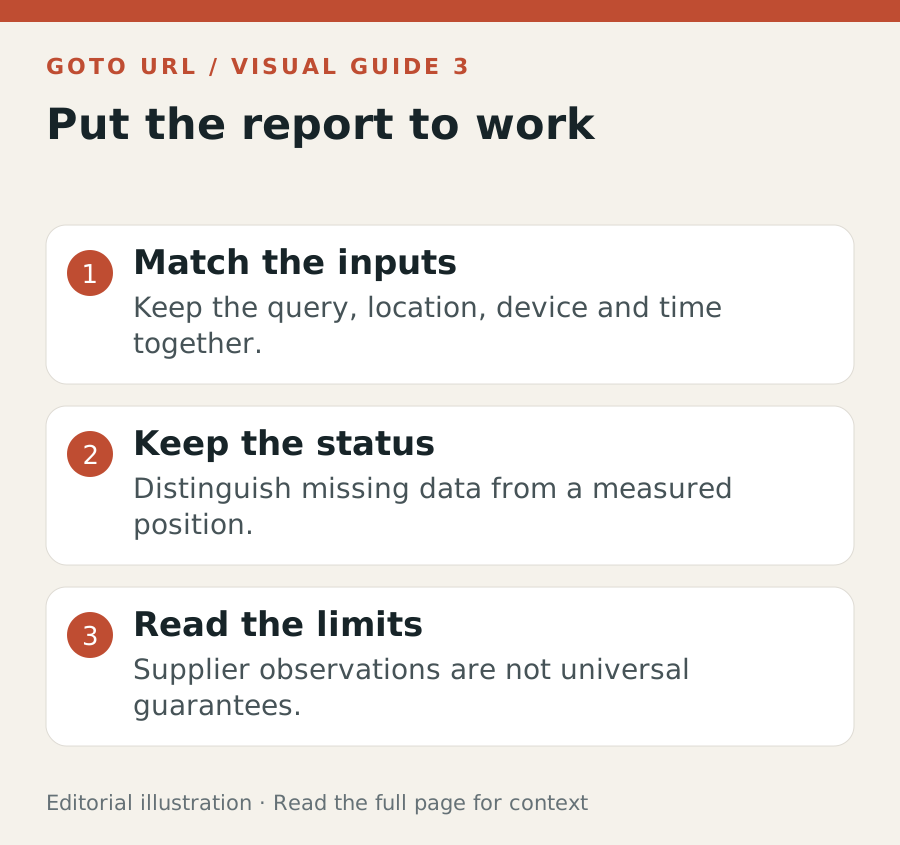
Take a matched sample of important queries, device and location settings. Retain the collection time, returned depth, final destination and any pending or failed status. Investigate Google-owned destinations and blanks before treating a missing observation as a ranking loss.
Ask whether a provider is returning older verified data, waiting for fresh results, or publishing partial output. Annotate affected reports and avoid triggering automated loss alerts from failed checks. For your own properties, compare Search Console clicks and landing-page outcomes alongside manual observations, recognising that those measures are not identical to a fixed rank check.
What remains unverified
We have not located a Google statement documenting the latest delay, its exact threshold or geographic reach. This article reports attributed observations; GoTo URL has not run an independent live-token benchmark. The cropped notice that prompted this investigation has no verified sender or author and is not attributed to a provider here.
The timeline separates this event from earlier access, depth and data-quality problems. There is no evidence in these notices alone that your website’s ranking or indexing changed.
Sources and verification
Checked 31 October 2026. We reviewed the public material linked below. We have not independently benchmarked the providers or tested live Google tokens for this article. A mutable status page may change after this check.
- SERP Lens update, visible on Brodie Clark’s LinkedIn profile ↗
First-hand tool update, retrieved 31 October. The profile feed is changeable; a permanent post URL was not verified.
- SerpApi: unresolved /goto links incident ↗
Provider status checked 31 October; incident opened 30 October at 10:39 UTC.
- SerpApi public issue #4315 ↗
Dated staff reports, including production impact on 30 October. The issue itself began in September.
- Ricardo Batista, Cloro: what broke on 30 October ↗
First-party measurements and a claimed workaround from a competing commercial provider.
- PrismCrawl: /goto verification delays ↗
Provider report published 30 October, describing a verification pause after the SERP loads.