Providers report new verification delays when resolving Google's /goto redirects. The evidence supports a fresh collection problem, but does not establish a universal rate limit or a ranking update.
The archive covers the major documented access, depth, redirect and data-quality developments relevant to this topic. It is not a catalogue of Google ranking algorithm updates or every undocumented experiment.
Providers report new verification delays when resolving Google's /goto redirects. The evidence supports a fresh collection problem, but does not establish a universal rate limit or a ranking update.
SerpApi's public notices document irrelevant results, empty paginated responses and valid searches returning no results. These should not all be described as /goto failures.
DataForSEO and SerpApi describe restoring direct destination URLs. Those notices record adaptation at a point in time, rather than a permanent end to redirect problems.
Google confirmed technical measures as /goto redirects spread more widely. Destination extraction became a distinct step for tools reading affected results.
Alex Greenland and Brodie Clark documented the redirect pattern before the wider rollout was confirmed. Derek Perkins said Nozzle had already encountered similar pages.
The loss of a dependable 100-results request increased pagination work. This predates the wider /goto discussion and concerns result depth, not destination decoding.
Google's JavaScript requirements affected how automated clients accessed search results. This was an access-layer disruption before the later depth and /goto changes.
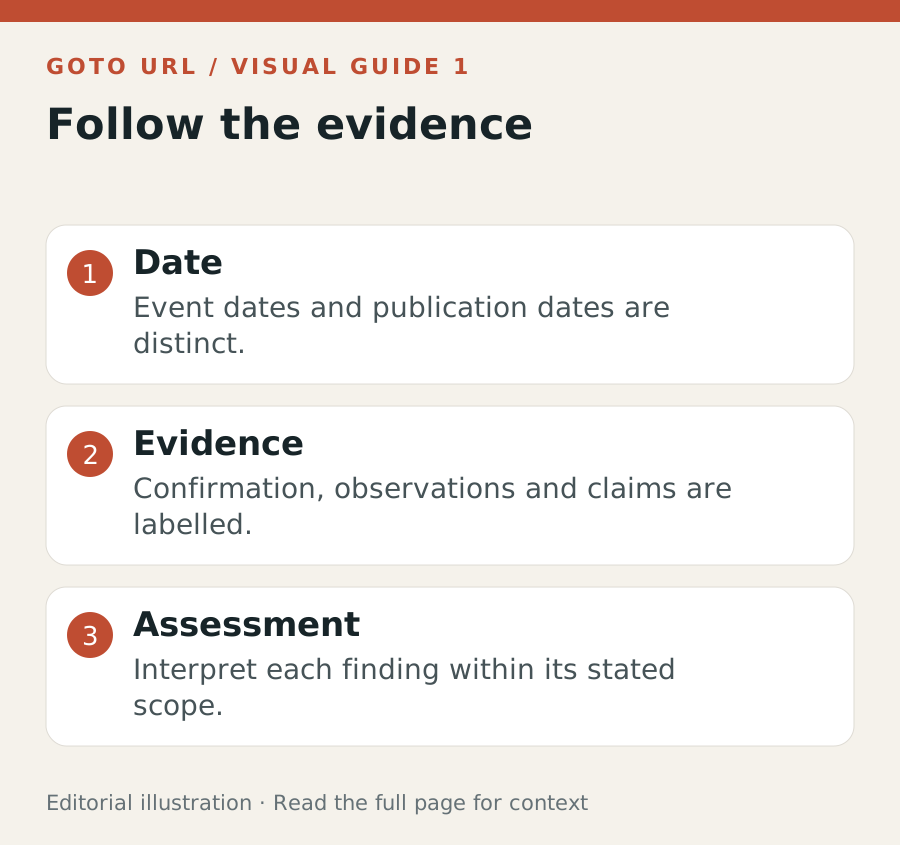
We identify Google confirmation, practitioner observations and supplier claims separately. A provider’s success claim describes its own system and test conditions. Our viewpoint explains the implications and the evidence still needed; it is not a new accuracy benchmark.
Event dates describe when something was observed or announced. Publication dates describe when GoTo URL wrote about it. Sources are linked on every article. Older resolution claims remain historical claims, even when later incidents appear.
Use dated source material and explicit evidence labels to follow the story.
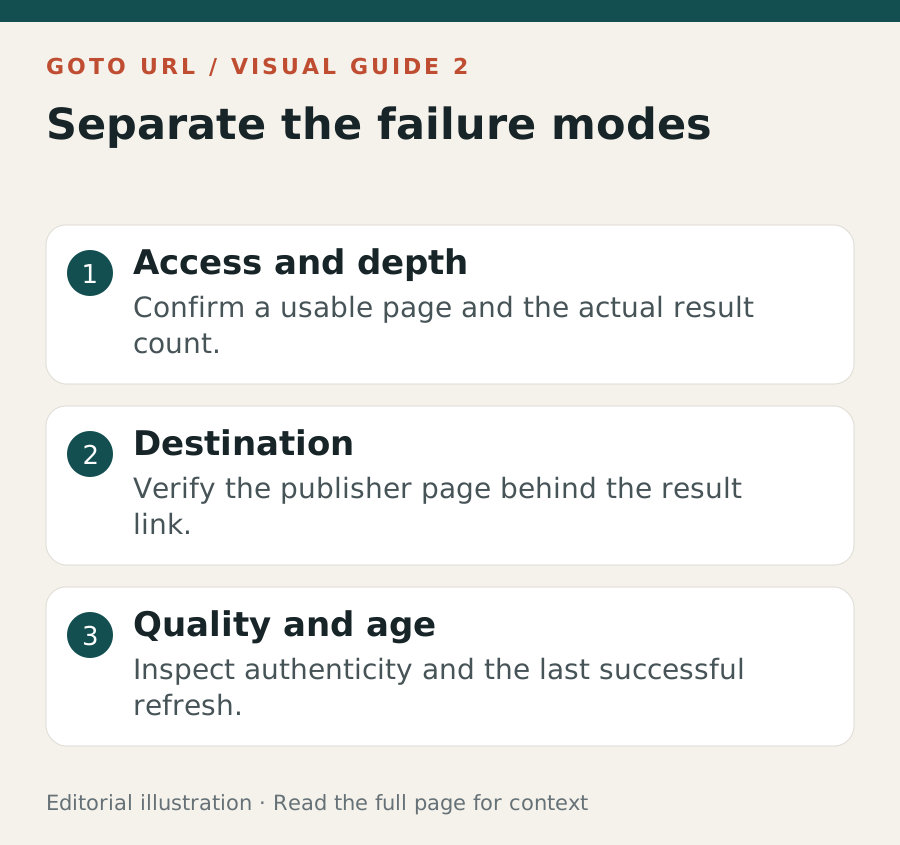
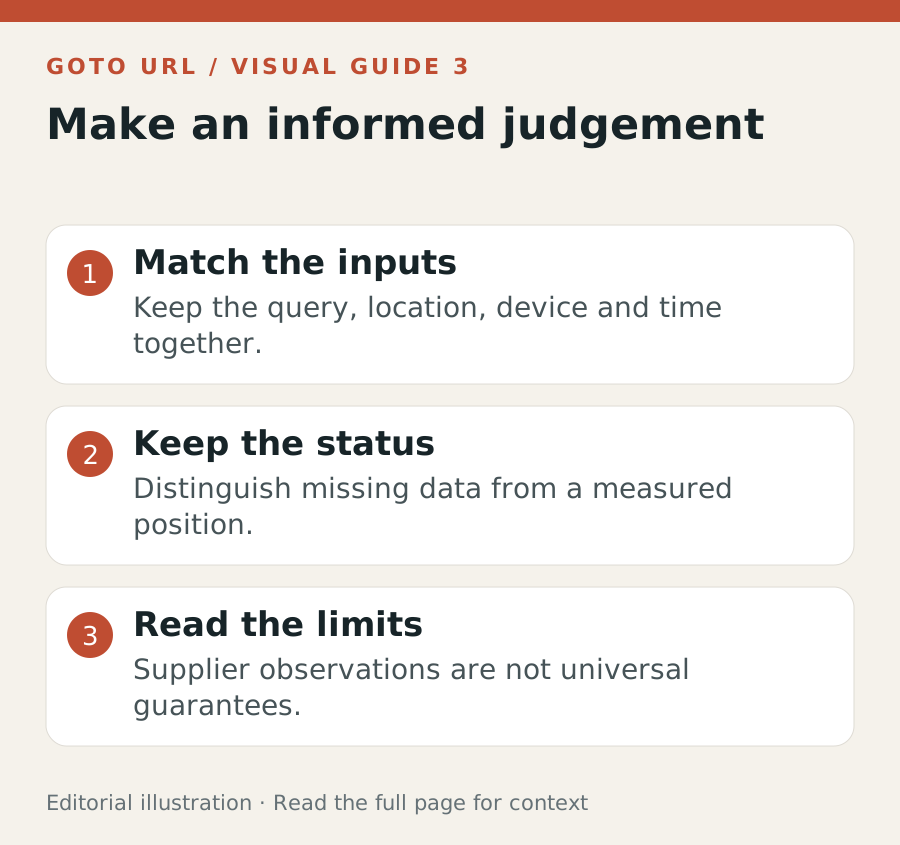
Diagnostic checklist for the search-data archive: access, depth, destination and freshness need separate checks.Reader checklist for the historical timeline: preserve comparable inputs, collection status and the limits of each source.