What SerpDino provides
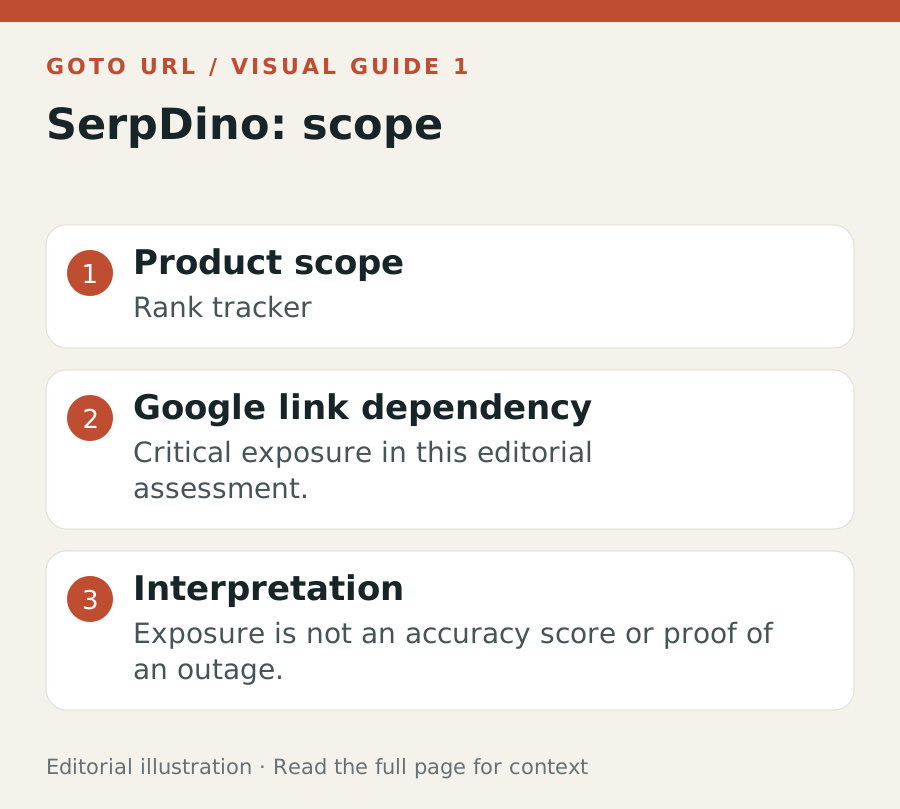
SerpDino is a specialist Google rank-monitoring SaaS for site owners, agencies and SEO teams. It operates its own collection infrastructure rather than reselling a third-party SERP feed.
It tracks Google rankings across 185 regions and 45 languages with top-50 or top-100 depth, on-demand and scheduled updates, complete top-30 SERP history, AI Overview detection, PageSpeed data and shareable reports. Paid plans also expose API and MCP access.
Where the redirect matters
The Google collector must map every observed position to a domain and landing page. Opaque redirects can force a new resolution step, creating a risk of missing URLs, false volatility, slower refreshes or higher collection costs. Full-SERP and top-100 tracking multiply that work across every keyword and location. SerpDino says it uses a proprietary in-house system, real Google SERPs and no third-party APIs. That makes the /goto parser and resolution burden its own operational responsibility and makes deep-result collection especially exposed.
/goto?url=[hash]resolve + attributepublisher URL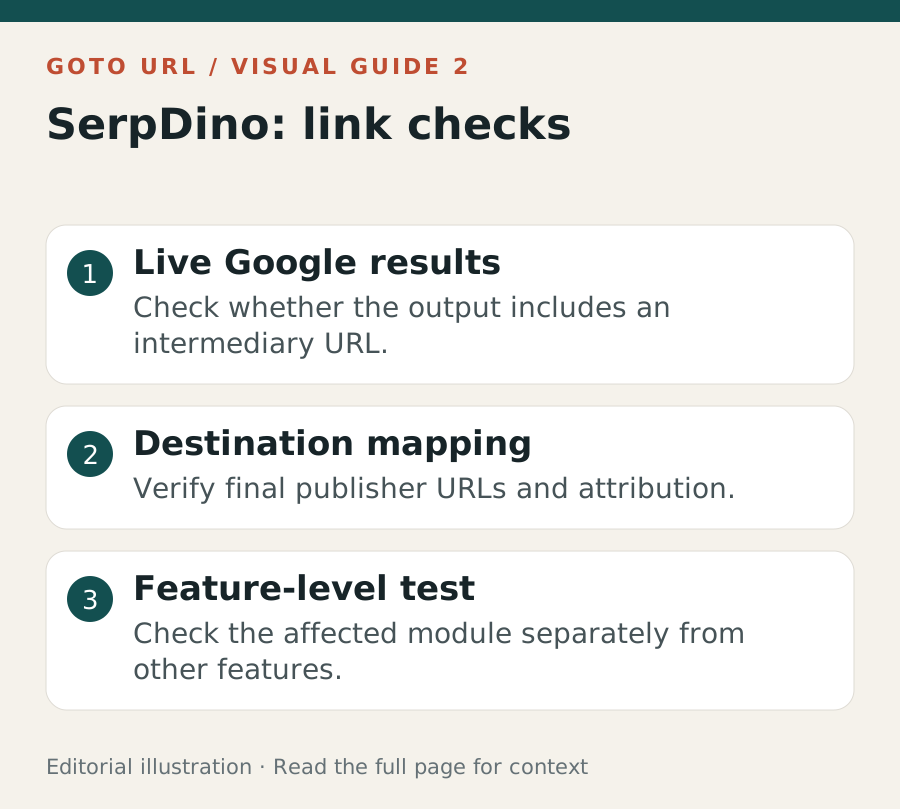
What SerpDino has said
Specific /goto responseSerpDino says Google’s change caused missing result pages and delayed position updates on 27 August. On 28 August it said URL-extraction gaps were fixed, normal collection had resumed and credits used on the affected day were refunded, while monitoring continued before final closure.
During the incident, SerpDino says it discarded incomplete SERPs and rechecked them rather than save false ranking drops. It later reported fixing URL extraction, but does not disclose the resolver, browser behaviour, token handling or proxy changes behind the repair.
This is strong operational evidence: it gives dates, symptoms, a temporary safeguard, restoration, a refund and an explicit monitoring caveat. Continuity and accuracy remain self-reported because no reproducible post-fix dataset or independent audit is published.
Rechecks did not consume customer balances and affected-day credits were refunded. No /goto surcharge was announced; existing extra credit use for deeper result collection is a separate product rule.
What is known — and what is not
The source record above is the latest attributable evidence located for SerpDino. Its stated outcome is not treated as an independent accuracy audit: the exposure rating still describes the relevant product’s dependence on resolving live Google result URLs.

What customers should monitor
- Top-50 or top-100 reports losing landing-page URLs
- Gaps between stored SERP snapshots and reported positions
- Changes to refresh speed, credits, API output or supported depth
What should remain outside the change
- Historical reports built from already resolved records
- Tracking on engines that do not use Google’s redirect
Read rank checks alongside Search Console
Match query, country, device and dates before comparing a tracker with GSC. Average position describes recorded impressions; it is not a fixed-location check. Review the reported page and clicks when a URL switches, and investigate whether the change is harmful before treating it as cannibalisation.
Use a fixed commercial watchlist alongside wider query discovery and lead outcomes. A missing check or incomplete SERP is not a measured ranking loss. Our SEO Stack review explains the measurements, and the Google analysis separates result-depth, access and URL-resolution failures.