The early record
Barry Schwartz’s 8 July report traces a public sighting to Alex Greenland on 23 June and discusses Brodie Clark’s subsequent observations. A reproduced 3 July comment from Derek Perkins says Nozzle had encountered such pages for months and discarded them before fetching replacements. Schwartz could not reproduce the behaviour at that point.
Evidence: Barry Schwartz: Google tests google.com/goto tracking URLs ↗
Our viewpoint: do not invent a single launch day
The evidence supports a test period with uneven visibility. It does not identify the first internal deployment or establish the share of all Google searches affected. ‘First documented here’ and ‘introduced globally’ would be different claims.
For historical analysis, preserve the distinction. A provider may have encountered a change earlier because of its clients, traffic patterns or experiments. That does not establish that a user’s ordinary browser should have shown the same behaviour on that day.
What an early warning should trigger
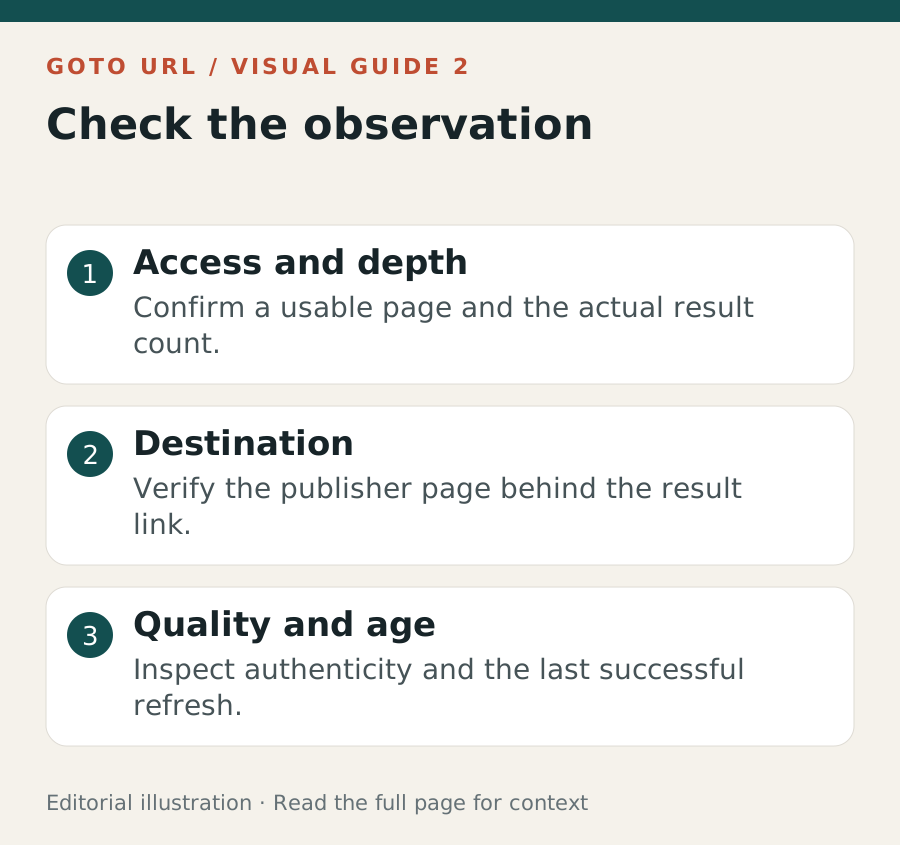
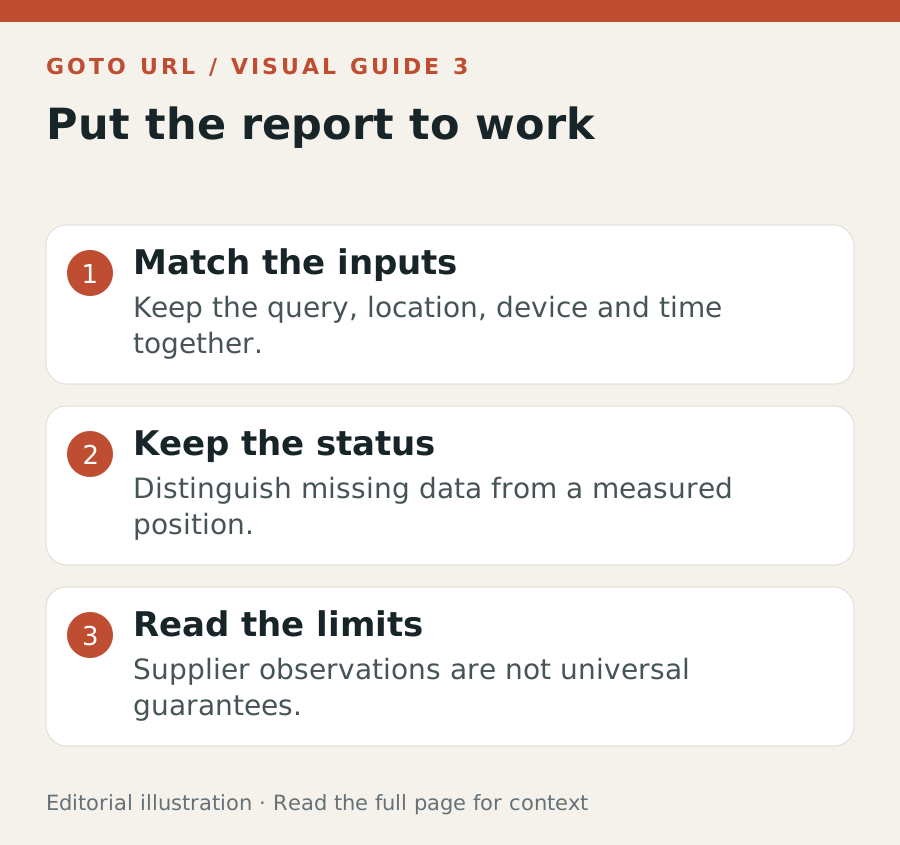
At this stage, the sensible response is to inspect outputs and document a repeatable case. Keep the query, location, device, session conditions and time. Identify whether the unusual address is in the clickable link, the displayed breadcrumb or a downstream export.
Avoid a site-wide rewrite of reporting assumptions from a screenshot alone. A narrow, reproducible observation is a useful warning precisely because its limits are explicit. Later confirmation can then be added without rewriting what was known at the time.
Sources and verification
Checked 31 October 2026. We reviewed the public material linked below. We have not independently benchmarked the providers or tested live Google tokens for this article. A mutable status page may change after this check.
- Barry Schwartz: Google tests google.com/goto tracking URLs ↗
8 July 2026; reproduces dated posts by Alex Greenland and Derek Perkins and links to Brodie Clark’s observations.