What was confirmed
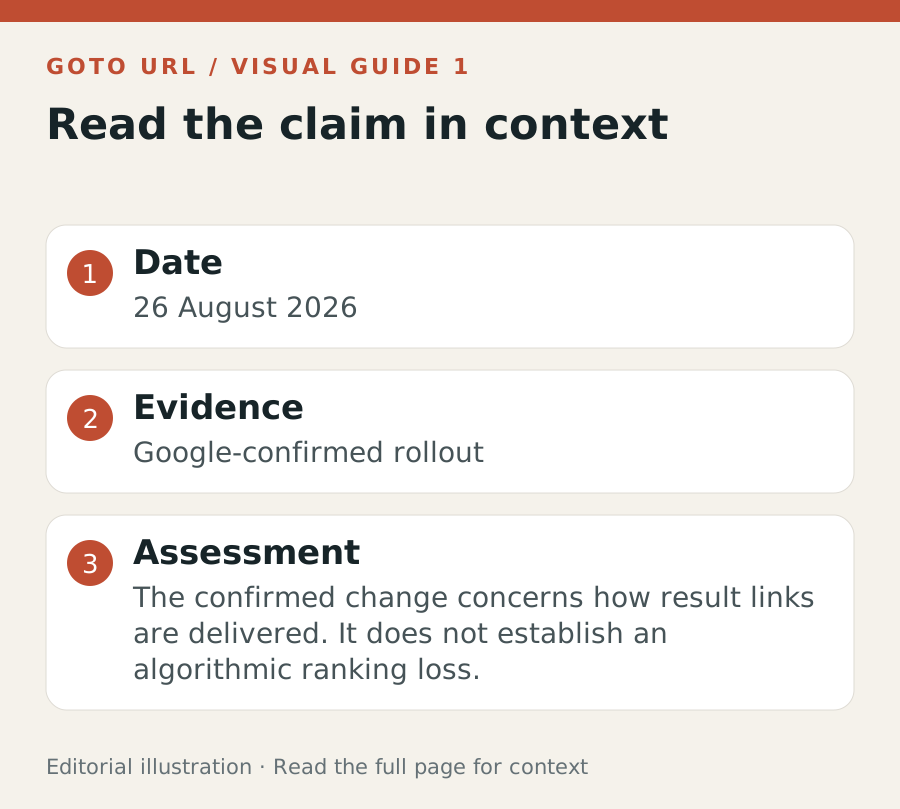
Barry Schwartz published Google’s confirmation on 26 August. The company described technical measures to protect its services and users from evolving abuse. Derek Perkins of Nozzle reported near-complete coverage across the residential providers he measured. His sample should not be read as proof that every browser and session received identical links.
Evidence: Barry Schwartz: Google confirms deploying goto URL redirects ↗
What the link change means
On affected results, the clickable address is a Google /goto intermediary carrying an opaque token. ScrapingBee’s tests describe recovering the destination from a GET redirect response, rather than decoding a readable address locally. Its browser comparisons also show why a collector should not assume one universal link format.
Our viewpoint
The distinction between the visible result and the destination behind its clickable link is the important one. If a data tool stores the intermediary as though it were the publisher, later domain grouping and page-level reporting can become misleading.
Google’s broad anti-abuse statement is not a complete technical explanation. It does not establish every target, the precise token design, or future rate limits. Those details need their own evidence. We should avoid presenting plausible commercial motives as confirmed engineering facts.
What to retain in your reports
Record the resolved publisher address separately from any intermediary. If resolution fails, preserve that status instead of attributing the result to Google. A missing landing-page address should be visible to the analyst.
Use the historical timeline to distinguish the start of testing from the broader confirmation. A gradual rollout can produce different vendor experiences on different dates without those accounts necessarily contradicting one another.
Sources and verification
Checked 31 October 2026. We reviewed the public material linked below. We have not independently benchmarked the providers or tested live Google tokens for this article. A mutable status page may change after this check.
- Barry Schwartz: Google confirms deploying goto URL redirects ↗
26 August 2026; direct Google spokesperson response and Derek Perkins’s rollout observations.
- ScrapingBee: handling Google /goto redirects ↗
First-hand technical tests; client behaviour can change.