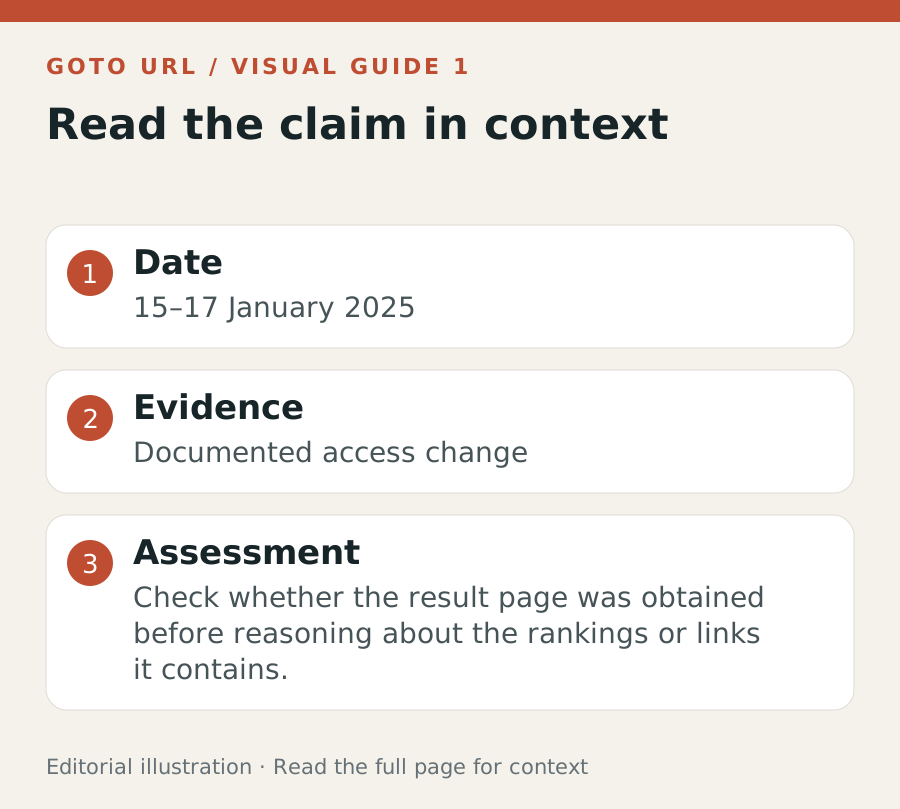
The documented change
Ryan Schafer’s 17 January SerpApi account dates new JavaScript requirements to 15 January. It describes increased collection difficulty, brief provider disruption and adaptation. The article also cites a Google spokesperson explaining JavaScript’s role in protection against bots and abuse.
Evidence: Ryan Schafer, SerpApi: Google now requires JavaScript ↗
Why it belongs in this timeline
This event affects access to the results page itself. It precedes both the later restriction on obtaining many results per request and the need to resolve intermediary links. Combining all three under one ‘Google update’ obscures what an engineer or analyst needs to investigate.
For a customer, each can appear as a missing observation. The correct diagnosis starts earlier in the chain: did the collector receive a usable results page? Only then can it count listings and inspect the destinations behind them.
Our viewpoint
This history supports treating collection reliability as an ongoing dependency. It does not prove an inevitable end to ranking tools. A provider’s ability to adapt is useful, but customers need failure visibility and realistic expectations about freshness.
When evaluating an assurance, distinguish a working browser demonstration from sustained collection under the conditions your project requires. Neither alone explains every other market or module. Retain the exact date and scope of any claimed fix.
Reporting lesson
Do not turn failed access into a position value. Store it as a failed or pending check and keep the last successful observation identifiable. If an alert system cannot distinguish a failed request from a genuine absence in a completed search, it can create false emergencies.
Start a historical annotation at the relevant collection incident, then test whether the visible business trend continues in independent data. That is a stronger basis for action than a sudden change in one dashboard alone.
Sources and verification
Checked 31 October 2026. We reviewed the public material linked below. We have not independently benchmarked the providers or tested live Google tokens for this article. A mutable status page may change after this check.
- Ryan Schafer, SerpApi: Google now requires JavaScript ↗
Published 17 January 2025; dates the observed change to 15 January and describes provider impact.